


They say Vallejo’s new True Metallic Metal range is the future of metallic paints – the best aspects of Vallejo’s previous metallic ranges combined, one range to rule them all. But can it be… true? I’ve tested the entire set, all 80 colours, every technique, every finish, every stress test, to see if these paints are truly revolutionary… or just the next product hype cycle.
On my desk today, I’ve got the complete True Metallic Metal range with 80 colours. I’ve spent a lot of time with these paints, spoken to the designers at Vallejo, and in this video I’ll demonstrate all sorts of techniques using Urkhan, the Dark Warden to find out whether the paints are really as good as Vallejo and Ángel claim:
Understanding the True Metallic Metal range structure
But first, let’s quickly cover a few important details about the range. There are 20 colour families, each with four paints, making 80 paints in total. You’ll find staples like silver, gold, copper, and bronze, but also plenty of vibrant coloured metallics from all over the rainbow. I’m really excited to try those out, as they look incredibly vivid in the promo shots. You can buy the paints individually in Vallejo’s 18 ml dropper bottles, as a complete case, or in four-paint bundles. But before you go all-in, be aware that the True Metallic Metal range does a few things differently from other paint ranges. Let me explain.
The BSL System explained: Base, Shade, Light, and Airbrush
So each of the 20 colour families consists of four paints. These four paints all share the same name (for example, Imperial Gold) but they’re not the same. The True Metallic Metal paints follow Vallejo’s BSL system, which stands for Base, Shade, and Light.
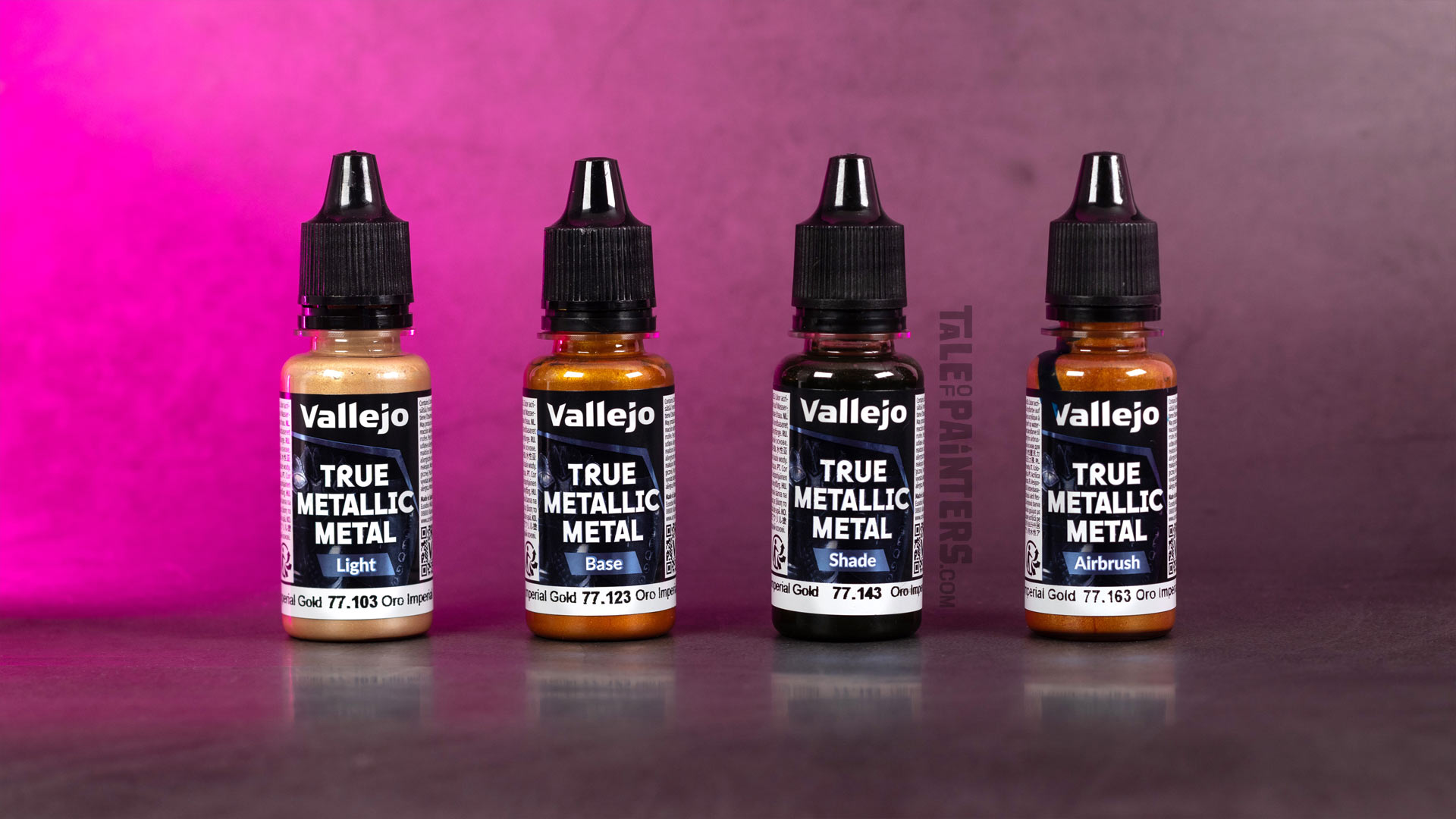
So for each family, you get a darker Base metallic, a lighter Light metallic, plus a dedicated Shade paint. Now, the Shade isn’t a metallic paint nor a wash like Citadel Shade paints. Instead, the Shades are based on Vallejo’s Xpress Color formula. So they are highly pigmented acrylic inks or “one-coat paints” similar to Citadel Contrast or The Army Painter Speedpaint. However, there’s a key difference: while Vallejo Xpress Colors dry matte, the True Metallic Metal Shades have a glossy finish so they don’t kill the metallic sheen. And the fourth paint in each family is an Airbrush version of the Base tone. Exactly the same colour, but pre-thinned and with added retarder to prevent paint drying on the needle of your airbrush.
So, to sum things up: the 80 paints in the True Metallic Metal range include “only” 40 unique metallic colours: 20 base, 20 light. The other 40 paints are the 20 Shades, and the 20 Airbrush versions of the Base colours.
Painting test: Chaos Warrior armour with the BSL system
Let’s start with the armour, where I’ll be using Vallejo’s BSL system as intended. For this, I’m using the Base colour from the Rusty Metal family.


True Metallic Metal paints need a really good shake, especially when opening them for the first time or after a long break. Occasionally a bit of excess medium may come out, just wipe it away. Then, the consistency is wonderfully homogenous and even. You don’t need to add any extra water; the moisture from a wet palette is perfectly sufficient for basecoating.
Paint application and coverage: first impressions
In the video, I’m applying the VTMM Rusty Metal Base to the armour, and it goes on beautifully smooth. I noticed the drying time is on the slower side. Many metallic paints tend to dry too quickly on the brush which results in a streaky texture if you’re not careful, but that’s not the case here, you have a bit of time to manipulate the paint. The self-levelling properties are excellent, with no bubbles or clumping. They are most similar to Vallejo’s updated Model Color metallics I would say, which makes sense, as it’s Vallejo’s most recent paint range. Compared to most other metallic paints I tested, the True Metallic Metal paints seem to have a higher pigment density and finer particles. Oh, and they’re also quite stable on a wet palette, especially when using these reusable sheets like in the Vallejo or Redgrass Games wet palettes.

After the first layer the covering power is pretty amazing already. I found that the Base paints usually cover in one to two coats over a dark undercoat, while the Light colours take about two to three. After two coats of Rusty Metal Base, the coverage is pretty perfect, and the finish is so smooth it looks almost like airbrushed. I absolutely love the finish, the metallic flakes are extremely fine, probably the finest I’ve ever seen, and have yet a nice sparkle. The product designer at Vallejo wouldn’t tell me which metallic flakes they’re using. I don’t think it’s aluminium, but whatever it is – the result speaks for itself.
Using the Shade paints: tips for best results
Following the BSL system, shading comes next, using VTMM Rusty Metal Shade. I’m testing it first on the foot. As you can see in the video, the dark brown Shade is very well matched to the Base colour. As I’ve mentioned, the Shade paints are based on the Xpress Color formula, so they’re all quite dark and strong (I reviewed Vallejo’s Xpress Color range here in detail). I think that’s fine for selective recess shading or blacklining, but for my taste they’re a bit too intense for an all-over application like on this Chaos Warrior’s armour. So I’m thinning the VTMM Rusty Metal Shade 1:1 with Xpress Color Medium to create a more wash-like consistency. Vallejo says you can thin Shade paints with water, but I prefer using medium. I find it keeps the flow properties more consistent.

Here’s how the model looks after the Shade wash, which added a lot of depth to the armour.
Highlighting and blending techniques with True Metallic Metal
Now I’m layering back up with the Base colour, using a trick I picked up from the demo session that Ángel Giráldez gave me. Instead of using the standard Base paint, I’m using the Airbrush version for this. More on the Airbrush paints in a moment, but they’re slightly thinner and contain retarder, making them also fantastic for blending and feathering. Then, into the still-moist Airbrush layer, I wet blend the VTMM Rusty Metal Light colour to build up volumetric highlights. Finally, I add a sharp edge highlight with the Light paint. And this is the result, following Vallejo’s full BSL workflow with the four colours you get per colour family.

I’m already quite happy with the armour, but to push the highlights even further, I mix some VTMM Sterling Silver Light into VTMM Rusty Metal Light and use it on the most pronounced edges. VTMM Sterling Silver Light is the brightest colour in the range, a metallic white that’s great for mixing. Its covering power is a little weaker than the other Light paints, but it’s worth noting that, compared to other white or pearlescent metallics I’ve tested from brands like AK and P3, this one is the first that actually has a noticeable amount of covering power at all. Now, I’m not the world’s best wet blender, but I’m genuinely pleased with how the armour turned out.
Drybrushing with True Metallic Metal: a faster approach
I also want to see how the True Metallic Metal paints perform using simpler, faster techniques such as drybrushing. For the shield and helmet, I’m going for a blackened steel look. I’m using the Obsidian Black family, the darker of the two silver families. As a little experiment, I’m airbrushing the shield with the Airbrush version, while brush painting the helmet and chest detail with the Base paint. You can really put the airbrush paints straight into your airbrush without any additional thinner. As you can see, the tone and finish are pretty much identical: a cold, near-black silver. Next, I apply VTMM Obsidian Black Shade as a wash, again thinned 1:1 with Xpress Color Medium. I think I should have added even more medium as the result turned out a bit patchy on the flat shield.

But once dry, it’s time for some drybrushing. For an even finish, I prefer round, domed synthetic brushes. My favourites are the Techlon Tiger Drybrushes from Chronicle, which I’ve reviewed here. I drybrush with VTMM Obsidian Black Light, which looks great, but I want a bit more pop, so go for another round with the Base colour from the VTMM Sterling Silver family. The True Metallic Metal range has two silver families – one dark, one light – that form a logical progression. As you can see, the True Metallic Metal paints drybrushed wonderfully here. A lot of coloured metallic paints lose a lot of their tint when drybrushing and become very silvery. This happens with metallics that combine silver pigments with a dye for the colouration. When wiping the paint off the brush, too much of the dye is often absorbed by the towel, leaving only the silver pigments to land on the model. But I think True Metallic Metal paints do quite well in this regard.
Painting metallics: chain, sword, and advanced techniques
Continuing with the silvers, I’m next tackling the chain on the shield. I start with Sterling Silver Base, wash with undiluted VTMM Sterling Silver Shade for strong contrast, then highlight with VTMM Sterling Silver Light. One thing I’ve noticed: all of Vallejo’s True Metallic Metal silvers lean towards a cold hue. If you’re used to the warmer silvers from Games Workshop, such as Leadbelcher or Iron Hands Steel, I’d recommend turning to Vallejo’s Mecha Color silvers instead. They’re technically airbrush paints, but they also work brilliantly with a brush. They’re also fantastic paints and match the Citadel Colour silvers almost perfectly.

The sword was then painted with VTMM Obsidian Black Light, and glazed and feathered with thinned VTMM Obsidian Black Base. Advanced techniques like blending and glazing are usually quite difficult with metallics. That’s because metallic pigments lose their bond more easily when thinned down. However, I found that the True Metallic Metal paints thin and blend remarkably well – almost as smoothly as standard acrylics.
Choosing between gold families
For the armour trims, I’m thinking of a bright gold or light bronze. There are actually three different gold families in the True Metallic Metal range, and their Light tones are quite similar, so you’ll need to decide if you really need them all. I recommend using my hand-painted colour swatch as a buying guide, where I’ve professionally digitised all the True Metallic Metal paints:

This hand-painted swatch is available in my Patreon shop for a small donation (or by becoming an Autarch tier member). I also have swatches for Vallejo Game & Model Color, Citadel Colour, AK 3rd Gen, Warpaints Fanatic, and Two Thin Coats – all cross-compatible with each other so you can compare colours across different brands. Check out my shop for details.
My chart not only shows real photos of each Base, Light, and Shade colour, but also how they look in combination. And as a bonus, I’ve included the Vallejo Metal Color range too.

Coloured Metallics for Horus Heresy and beyond
Last but not least, I need to take you through all the coloured metallics. And honestly, they’re absolutely stunning! Up to now, coloured metallics have only appeared in a handful of paint ranges, but Vallejo’s True Metallic Metal range includes 11 different colour families.
Now, the problem with coloured metallics so far has been that they often looked quite silvery or pastel. Here’s WPF Gemstone Red from the Warpaints Fanatic range, and here’s Two Thin Coats, which up until now had the best coloured metallics I’d tested so far. Now compare those to the two Red Base paints from the True Metallic Metal range: the vibrancy is just on another level. And you just need to apply two layers for them, maybe three at most.

And here you can see VTMM Forge Red Base and VTMM Hydra Turquoise Base on test models. Absolutely perfect for Horus Heresy Thousand Sons and Alpha Legion. The other colours are brilliant as well. For instance, in the video there is a test model I painted with the Sapphire Blue BSL System during Angel’s workshop at Spiel con.

The colour I might find the most terrific, though, is VTMM Radiant Yellow Base. It’s a genuine yellow metallic that isn’t a gold. It looks a bit flat on camera, but in person it has a lovely metallic shimmer. It’s one of the few base colours that need more than two coats over a dark undercoat, so I’d recommend either airbrushing or applying a layer of brown first. Still, it looks so freaking good, and I can’t wait to see some metallic Imperial Fists painted with it.
Value
Vallejo True Metallic Metal paints are already available in Europe and will arrive in other regions shortly. You can buy the paints as a complete case with all 80 colours, some (but not all) colour families in four-packs (with Base, Shade, Light, and Airbrush), as well as individual colours. With an RRP of 4.30€ per 18 ml dropper bottle, the True Metallic Metal paints are 1.10€ more expensive than Vallejo Game and Model Color paints and metallics. However, at most of our partner shops you can secure at least 10% savings:
You can find the latest hobby products at our 🇬🇧/🇪🇺 partner stores Wayland Games, Element Games, and Firestorm Games, at 🇩🇪 Taschengelddieb and PK-Pro, and at 🇺🇸 Noble Knight Games with a welcome discount of up to 10 – 15% over RRP. Using our links helps to support Tale of Painters at no additional cost to you, so thank you very much for using them!
I hope you found this review helpful, feel free to leave a reaction or comment below, or post your questions here or discuss on our Discord channel.
9.0 Score
Pros
- Extremely fine metallic particles with excellent coverage (one to two coats for Base colours)
- Outstanding coloured metallics with vibrant, non-pastel tones
- Superb blending and glazing properties, almost like regular acrylics
- Excellent self-levelling and smooth application
Cons
- More expensive than most other brands and Vallejo's other ranges
- Airbrush versions might be redundant for brush painters
- Shade paints may be unnecessary if you already own a lot of washes and Contrast paints
Final Verdict
Vallejo already makes great metallic paints, and with True Metallic Metal, they've managed to combine the best aspects of all their previous metallic ranges into a single product. All in all, Vallejo's True Metallic Metal paints are honestly among the very best metallic paints I've ever tested. I really don't know how they could possibly become any better without breaking the laws of physics. Before you go all-in, however, ask yourself whether you really need the Base/Airbrush colours twice and all those Shade paints.

1 Comment
Leave a Reply
Tale of Painters is the unofficial Warhammer hobby magazine run by hobbyists like you. Support our work by using the affiliate links from our 🇺🇸 / 🇨🇦 partner stores for your next orders so we can continue to bring you fantastic FREE content every day:


Or support us directly:



Thanks for the, review, it was fun and thorough as always . I was keen on the paints after watching Juan Hidalgo’s videos. My own set of the Ruby colour arrived today (two months early) and I can confirm they are lovely to work with. The pigment the paints use may be mica. Mica would be that fine and would hold its colour as the colouring is natural or done with chemical bonding (I’m not a chemist so my terms will be clumsy). It’s been used in resin and other types of art before but I have not seen it in an acrylic hobby paint.