


I’ve tested the complete Ultracryl paint range – the Kickstarter sensation from Germany. Premium acrylic paint with maximum pigmentation and the finest raw materials money can buy. What could possibly go wrong? Well… this is without a doubt the most difficult review I’ve ever had to make. Read on to find out why.
You hear a lot of good things about Ultracryl, but since the Kickstarter has been fulfilled some more critical voices have started to emerge. To get to the bottom of it, I’ve prepared three segments for this video review:
First, I’ll give you an overview of what Ultracryl does differently from other hobby acrylics. Second, I’ll put every paint type through its paces on test models: priming, airbrushing, covering power, techniques like feathering and blending, and of course the fluorescent paints and metallics. And at the end you’ll get my honest verdict on whether I’d recommend Ultracryl or not.
What makes Ultracryl different from other hobby acrylics?
Ultracryl was a pretty successful Kickstarter from Ten01 Labs, which are three guys from Germany who spent over four years developing what they set out to make the perfect miniature paint. Ultra pigmentation, ultra saturation, ultra opacity, ultra matte, ultra flow. Everything ultra. The paints are now also available on their own website. Pricing for individual bottles is reasonable: €3.88 or €4.76 for 20ml depending on the pigment raw material costs, though the metallics come in at just under €6, I’ll explain later why they’re more expensive.

The bottles are longer and thinner than standard dropper bottles, with very fine nozzles similar to TT Combat paints, which actually suits the fluid consistency well. Though they can clog up sometimes. The labels list the exact pigments used, so perfect for pigment nerds. Opacity and lightfastness is also indicated. Ultracryl uses the highest-quality pigments you’d normally only find in expensive artist paints, in clean mixes without fillers.

The palette is compact with only 72 colours, and they distinguish between the R-Series, which targets maximum covering power for hobbyists, and the mono-pigment M-Series, where each paint contains just one pigment and can be more transparent (and often more satin/glossy). Those are aimed at more advanced painters and are meant to be used similarly to artist paints.
Putting Ultracryl through the paces
All of that sounds fantastic. Extremely high quality on paper. In practice, though, I ran into some difficulties. I also have a theory about why, and I’ll explain all of it now on a Stormcast Eternals test model.
Ultracryl in the airbrush: stunning results, but a rough texture problem emerges
First I use the grey primer to prime the model through the airbrush. It doesn’t really need thinning when spraying at around 25 to 30 PSI with a 0.3mm nozzle. Coverage is excellent, and the result is ultra matte, though it does leave a slightly rough texture, which you can see on the chest armour.

I went with the Astral Templars colour scheme, using Quinacridone Magenta Transparent as the base colour. As the name suggests, this is a more transparent paint, so I built it up in several thin coats through the airbrush, adding just a few drops of Ultracryl’s airbrush medium. The pigment used (PV19R) has an ultra-high saturation and vibrancy for such a dark magenta. The camera can barely capture its depth. Next I sprayed some shading with Dioxazine Violet Transparent. Also a transparent colour, but perfect for airbrushed shading. The result already looks very promising, it’s incredible how these colours glow. The armour is now an extremely deep magenta tone with beautiful gradients, though the rough texture has become noticeably more pronounced with the additional paint layers.
Brush painting Ultracryl: where things start to go wrong
Ultracryl markets itself on ultra covering power. Let’s see whether that holds up for brush painting too. I paint the shield with Titanium White, straight from the bottle without thinning. Ultracryl paints are fluid, more like pre-thinned airbrush paints, but still highly pigmented. It’s a common misconception that thin paints are inherently less pigmented than thicker ones. Thicker paints often just contain more thickening agents or fillers, and if Ultracryl feels too thin for you, you can mix in some of their thickening medium.
As you can see in the video, the covering power is very high, but an uneven texture built up, almost as if the pigments are clumping together. For anyone who backed the Kickstarter, is this happening to you too? Let me know in the comments. Ten01 Labs are aware of the problem, and it particularly affects paints containing the yellow PY184 pigment. Bismuth Yellow and Lemon Yellow are the worst offenders. After I gave this feedback, I received updated versions of those colours, but unfortunately the Bismuth Yellow is still extremely clumpy. I hope this gets fixed soon, if there’s any news, I’ll add an update to this post.

Next I want to shade the shield using the feathering technique. I thin Titanium Buff with water to a heavy glaze consistency and apply the glaze around the lightning bolts. Then I feather it out into the white with a clean, slightly damp brush. And this didn’t work at all. The paint breaked apart and smeared, I’ve never seen anything like it. I switched from water to Ultracryl’s “Ursuppe” medium, which helps, but a smooth blend is still very difficult to pull off and a coffee-staining effect remains. I have a theory about why this happens, which I’ll get to in a moment. For the next step I painted Yellow Ochre thinned with medium directly into the recesses around the ornament without feathering, which worked a bit better. In the end I patched over the problem areas with thinned Titanium White, but I’m not happy with the result.

The polyurethane binder: a theory about what’s really causing the problems
Here’s my theory about what’s causing this. Beyond the high-quality pigments, Ultracryl has another distinctive feature: the binder. Instead of conventional acrylic resins, Ultracryl uses a hybrid of acrylic and polyurethane. Polyurethane is commonly used in airbrush primers and varnishes because of its stronger adhesion and durability. The problem is that acrylic and polyurethane don’t play particularly well together chemically, and even though Ten01 Labs promise the best of both worlds, my suspicion is that it’s the binder medium causing my issues with Ultracryl. Perhaps the paints are also overpigmented, because there is a limit of how much pigment a paint can actually take.
But back to the Stormcast. I give the armour some panel lining by painting slightly thinned Dioxazine Violet Transparent directly into the recesses and around the rivets. That works well enough, the more satin transparent colours do seem less affected by the smearing issue. Then I want to add some edge highlights. A thin consistency combined with high covering power is actually an ideal combination for edge highlighting.
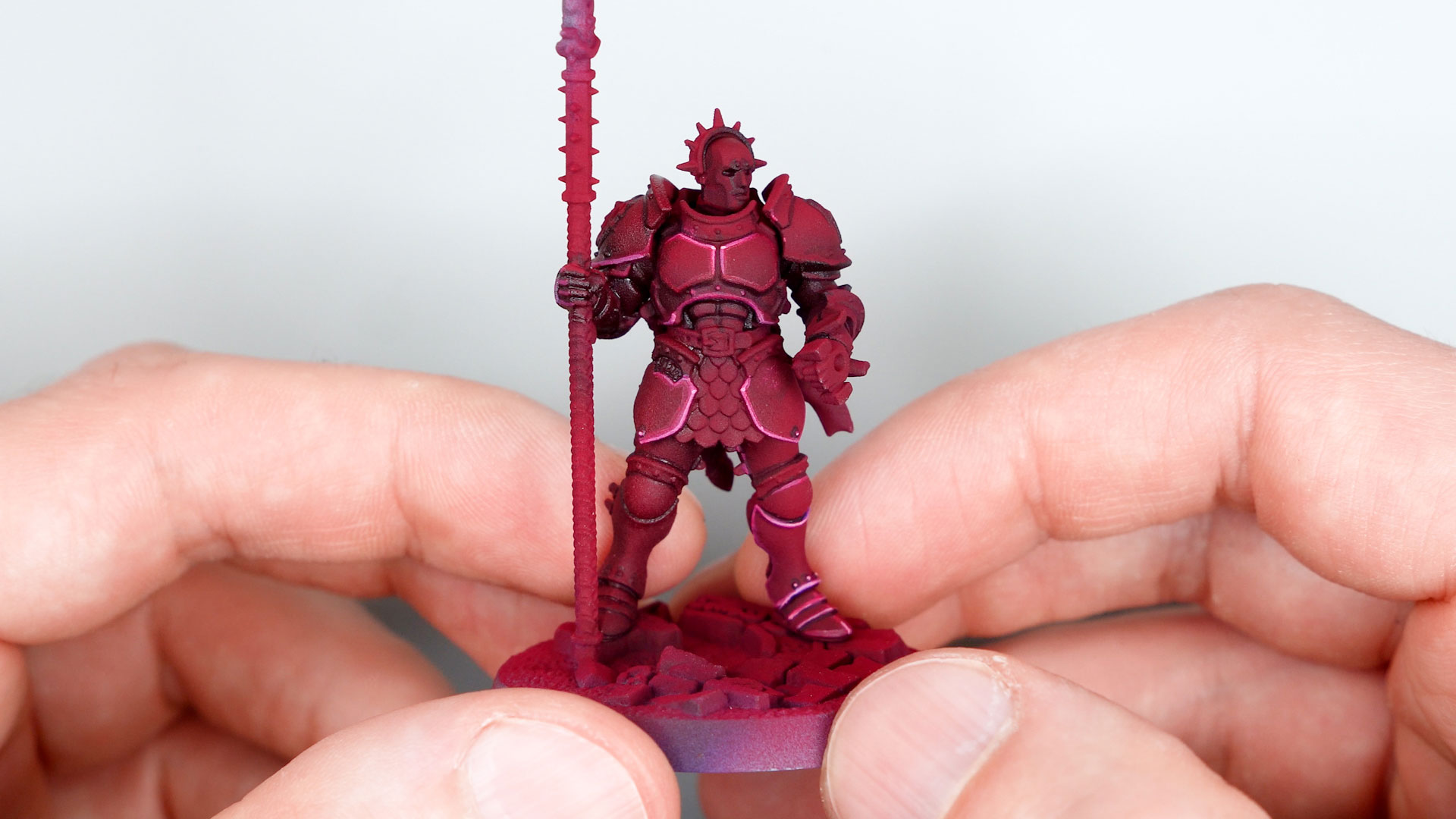
So I mix a little Quinacridone Carmine Red into the Magenta Transparent. The very rough texture from the airbrushed layers made the flow from brush to model less than ideal, but it was doable. The ultra high opacity combined with the ultra-matte, slightly chalky finish does take some getting used to, though. And anywhere I try to feather out the highlights slightly, we’re back to the smearing/coffee-staining problem. Most noticeable on the left hip plate. I had intended to paint the whole model, but at this point I just gave up.
Further testing: clumping, bubbles, and a frustrating pattern
Off camera I ran further tests because I simply couldn’t believe the paint was giving me this much trouble. For one thing, I painted all the colours onto plasticard for my Stahly Swatch System and had them professionally digitised. You’ll find a colour swatch for all Ultracryl colours on my Patreon for a small donation, along with swatches for many other hobby paint ranges. With these you can easily compare colours across different manufacturers so you never have to buy the wrong colour again.

This hand-painted swatch is available in my Patreon shop for a small donation (or by becoming an Autarch tier member). I also have swatches for Vallejo Game & Model Color, Citadel Colour, AK 3rd Gen, Warpaints Fanatic, and Two Thin Coats – all cross-compatible with each other so you can compare colours across different brands. Check out my shop for details.
I also painted additional test models, like a Stahly bust, using Pyrrole Red as a starting point. Again, excellent covering power, but you really need to take care not ending up with a clumpy texture. I also noticed that the Ultracryl paints sometimes tend to leave bubbles on the model that don’t pop on their own while drying. Feathering and shading produced a similar smearing as on the Stormcast shield. Wet blending worked somewhat better, as you can see on the Aeldari’s chest plate. And on the Stormcast’s dagger sheath, where I blended Skintone 5 into Skintone 4. I have to mention that other paints like P3 still blend far more easily for me. While I’m not a Golden Demon winner, I’m genuinely not a bad painter.
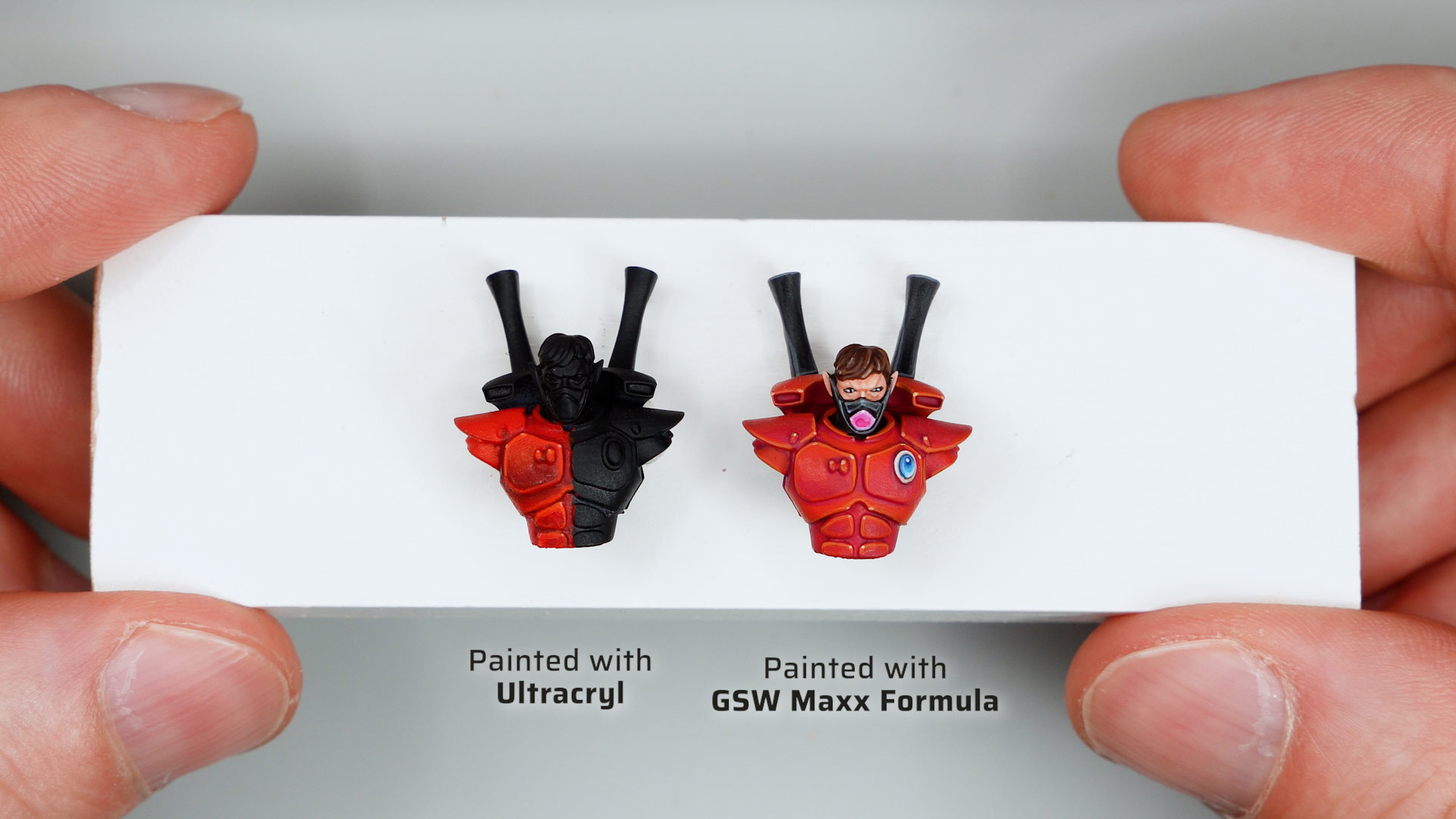
Here for comparison is another test model I painted for my Green Stuff World Maxx Formula review. But the model on the left is simply the best I can get out of Ultracryl.
Ultracryl fluorescent paints reviewed: great potential
Next up, before I try the metallics, I want to test the fluorescent paints. I’ve heard very positive things about these from a well-known German creator colleague.
I want to give the eye sockets a fluorescent glowing effect, so I start by base coating them with Titanium White. Then I pick up the Fluo Red – but unfortunately, in all of my Ultracryl fluo paints from the Kickstarter production run, the pigments had completely separated and clumped to the bottom after just a few weeks. Even a vortex mixer or stirring rod couldn’t do much about it. All that comes out is lightly tinted medium. I try to do my best as the pigmentation is so strong that even the medium has quite a punch. But the consistency is so thin that I can’t control the paint at all. It just runs straight into the eye sockets. It’s a shame because the fluorescent paints have real potential, but in this state they’re rather unusable. The issue has already been raised in the Ten01 Labs Discord and a fix is being worked on – I’ll update as soon as I know more.
Ultracryl metallics reviewed: extraordinary reflectivity, tricky to use with a brush
There are 8 metallics in total, and at just under €6 each they’re the most expensive paints in the Ultracryl line up. That’s because they use the highest-quality metallic flakes currently available: Zenexo pigments from Schlenk, which are glass-coated aluminium pigments with extraordinary reflectivity and opacity. Let’s see how they look on a model.
The Ultracryl metallics feel even thinner than the acrylics. They have an almost quicksilver-like quality. They remind me strongly of Vallejo Metal Color. Because they’re so fluid and the pigments tend to settle into recesses, you need three to four coats with the brush despite the high covering power. The finish is… quite interesting. The reflectivity is very high, noticeably higher than many other aluminium-pigment metallics. But the rough texture from the Ultracryl primer gives the finish a very grainy appearance.
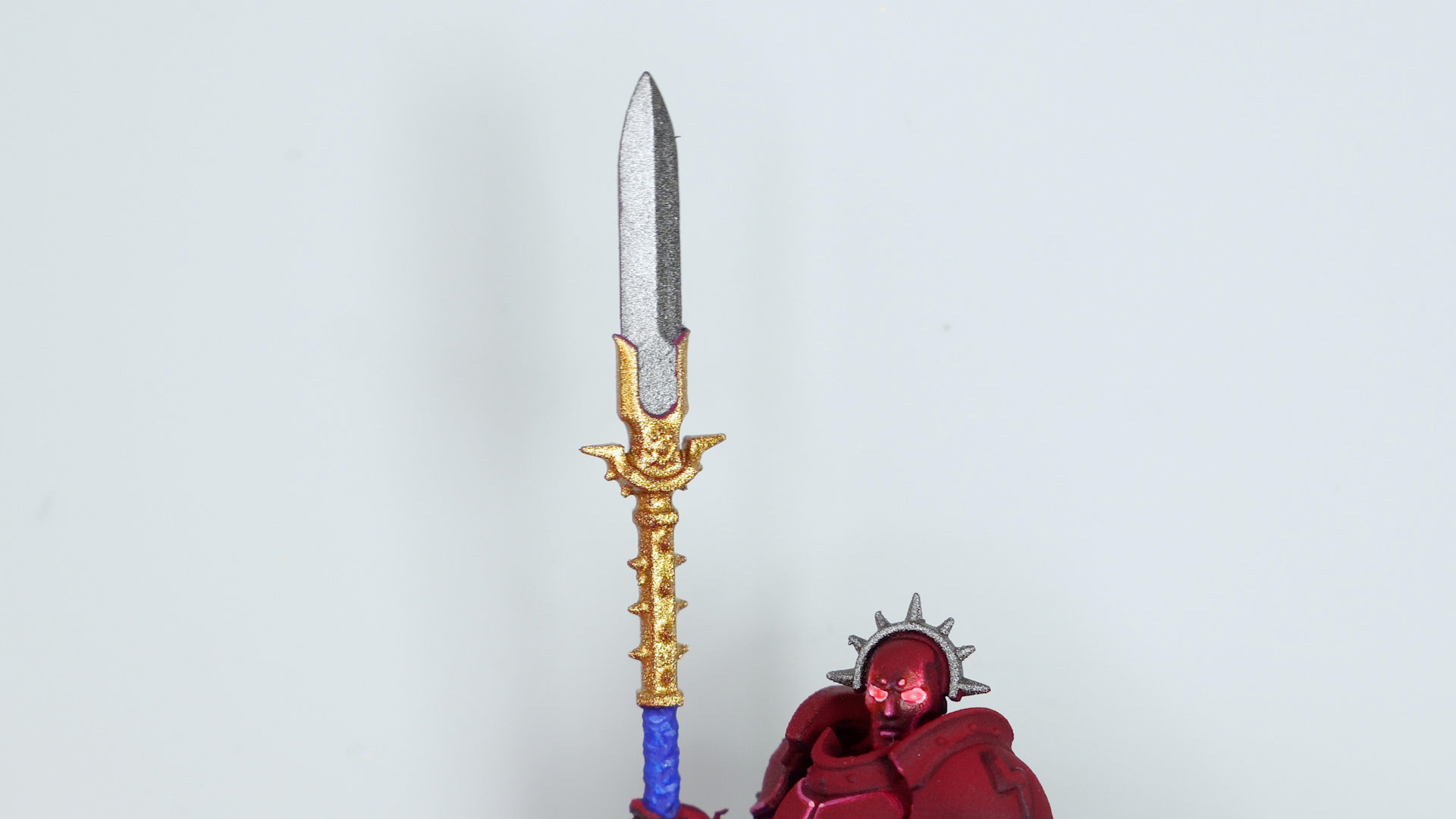
I also tested the metallics on a Stahly test model primed with a smooth coat of black spray primer. The result looks much better, check the video. Even though the particles are very fine, there’s still a slight graininess, but in return the Ultracryl metallics reach the gloss and reflectivity level of lacquer-based metallic paints. As a side note, from what I understand the Zenexo pigments are also used in the extra-premium Pure Metallics from P3’s second wave (see my first impressions here). I have a comparison with the P3 prototypes in the video – as you can see, the colours are virtually identical. The P3 metallics do have more body and are easier to work with on the brush though. Given the thin consistency of the Ultracryl metallics, I’d actually recommend them more for airbrushing.
A comment on the other Ultracryl reviews
With this fair share of criticism, you might be wondering why other creators and YouTubers have praised Ultracryl so highly. Honestly, so am I. I’m not accusing anyone of being dishonest. My theory is that since those videos were made two or three years ago at the start of the Kickstarter campaign, something changed between the prototypes and the final production run. It’s a real shame, but I hope the team at Ten01 Labs take the feedback on board and keep improving their paints, as there is real potential in Ultracryl.
Where to get
Ultracryl is available directly from the Ten01 Labs website.
You can find the latest hobby products at our 🇬🇧/🇪🇺 partner stores Wayland Games, Element Games, and Firestorm Games, at 🇩🇪 Taschengelddieb and PK-Pro, and at 🇺🇸 Noble Knight Games with a welcome discount of up to 10 – 15% over RRP. Using our links helps to support Tale of Painters at no additional cost to you, so thank you very much for using them!
I hope you found this review helpful, feel free to leave a reaction or comment below, or post your questions here or discuss on our Discord channel.
4.0 Score
Pros
- High concentration of premium artist-grade pigments
- High covering power while retaining a thin and fluid consistency
- Mono-pigment paints available, all pigments listed on the labels
- Highly reflective aluminium metallic pigments
Cons
- A lot of colours tend to leave a clumpy, uneven finish
- Smearing and coffee-staining effect when feathered and glazed
- Strong separation makes fluo paints nigh unusuable
- Metallics are a bit tricky to use with a brush
Final Verdict
This review really wasn't easy for me. In defense of Ultracryl: they have ultra-premium pigments that you'd normally only find in artist-grade acrylics. The paints are ultra-matte, which does unfortunately give them a chalky finish, and many colours tend to leave a clumpy texture – especially the yellows. You also need to watch out for bubbles. The polyurethane hybrid binder just doesn't seem fully dialled in yet, because the paint really fails at feathering and glazing, where the pigments smear and/or leave coffee-staining rings. Despite all that, I believe there is genuine greatness hiding inside this range. The pigment quality is clearly exceptional and the covering power is brilliant. But the usability just isn't there yet.

1 Comment
Leave a Reply
Tale of Painters is the unofficial Warhammer hobby magazine run by hobbyists like you. Support our work by using the affiliate links from our 🇺🇸 / 🇨🇦 partner stores for your next orders so we can continue to bring you fantastic FREE content every day:


Or support us directly:



I suspect some of the paint components have been affected by cold weather before mixing during their production process.