


Green Stuff World have released six new patina paints that oxidise just like the popular Dirty Down paints. But without the solvents, without the smell, at a lower price, and with extra colours like soot and dirt. In this video, I put all six Green Stuff World paints head-to-head with Dirty Down to find out which patina paint pulls off the best effects.
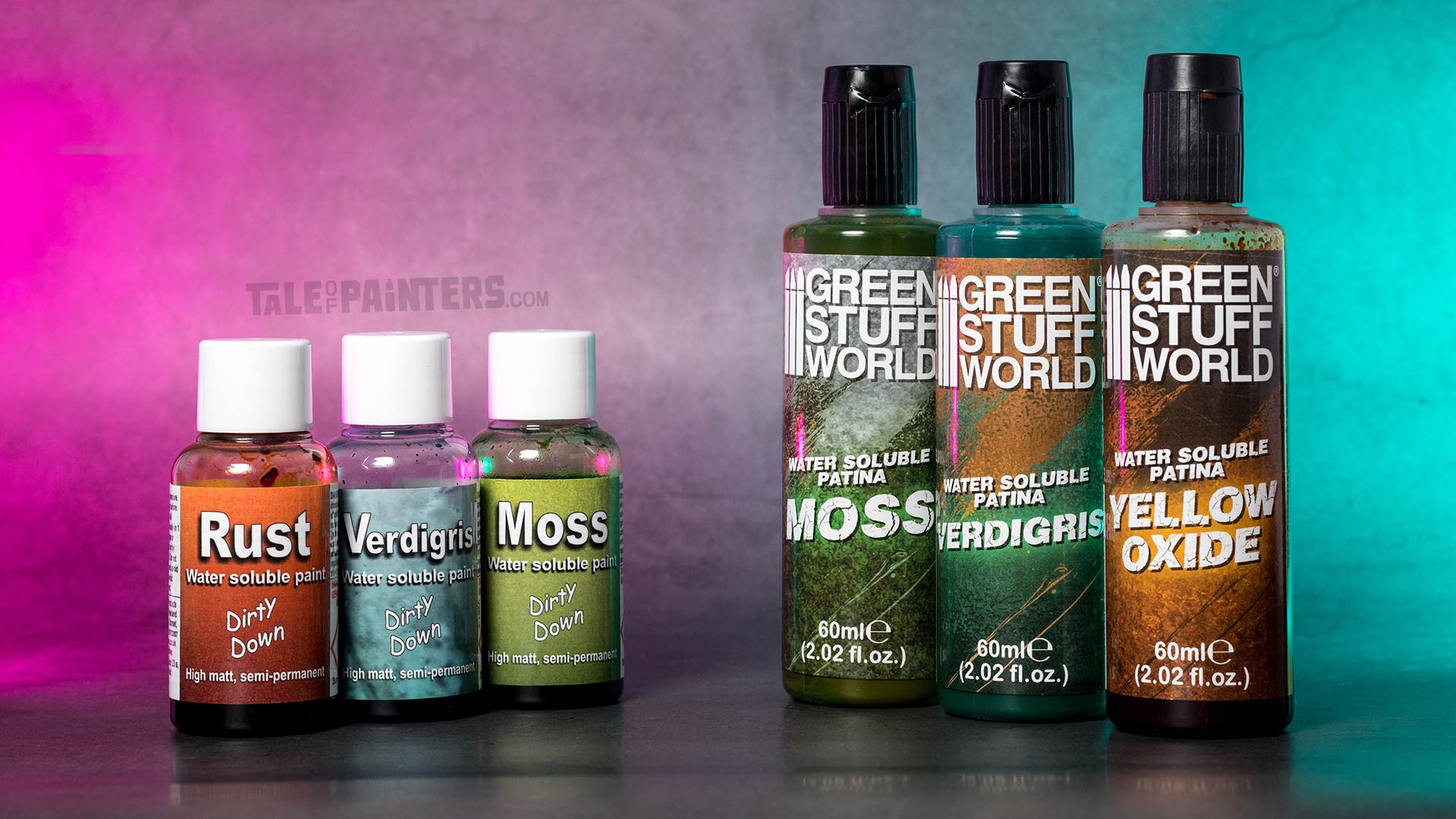
Green Stuff World are the kings of special effects paints, and whenever something new hits the hobby market, it usually doesn’t take long for them to release their own version. Their new water-soluble Patina paints oxidise as they dry, creating a super realistic texture. You get a greenish and a turquoise verdigris, a yellow oxide rust, a moss paint, plus Black Soot and Filthy Dirt.
This epic versus video has three parts: first, I compare all the patina paints against their Dirty Down counterparts, second, I show you the two exclusive soot and dirt colours, and at the end, I’ll choose a winner, you’ll get my verdict, and maybe even some better alternatives:
Pricing and packaging: more paint for less money?
The Green Stuff World Patina paints are available as a six-piece set or individually, in generous 60ml bottles. There are also extra-large 240ml bottles. The 60ml bottles cost around €8 to €9, which is roughly the same price as the 25ml Dirty Down bottles, plus you often get discounts from Green Stuff World. So you’re getting more than double the volume for your money.
Green Stuff World Patina vs. Dirty Down: which oxidation paint wins?
Now for the big face-off. I’ll go through the verdigris, rust, and moss products from both manufacturers one by one, and then we’ll look at the exclusive soot and dirt.
Round 1: Verdigris and Turquoise oxide put to the test
For the verdigris comparison, I’ve prepared some test bases and sprayed them with WPA True Copper from the Warpaints Air range. Green Stuff World offers not one but two verdigris colours: the greenish GSW Verdigris, and the more bluish GSW Turquoise Oxide. Before you can use these paints you need to pierce a hole in the cap with something sharp. I’m not a big fan of these nozzles with this type of paint, because the patina paints gunk up the cap pretty quickly and block the nozzles.
I start Green Stuff World Verdigris followed by GSW Turquoise Oxide. I apply the paints lighter at the top while concentrating more on the recesses, then go heavier and thicker towards the bottom. The consistency feels like an acrylic wash, but as you can see, there are some small lumps in the paint. I’m not sure whether that’s intentional or a weird side-effect of this paint. Have you tried the Patinas yet, are yours the same? Please tell me in the comments. Because they contain no solvents, these paints are completely odourless and produce no fumes, which is a big plus.
I repeat the process with Dirty Down Verdigris, and the first thing that strikes me is the smell. Takes me straight back to the smell of Chaos Black and Skull White spray primers of the 90s. Good times, but not great for your lungs. Make sure you work in a well-ventilated area and ideally wear a respirator (like this one).
Waiting for the oxidation takes some patience
Now we wait, because these paints oxidise as they dry on contact with air. The Green Stuff World Patinas take quite a long time, at least 15 minutes, and in areas where you’ve applied a thick coat it can take up to half an hour. Dirty Down is faster, the effect starts developing after just around 5 minutes.
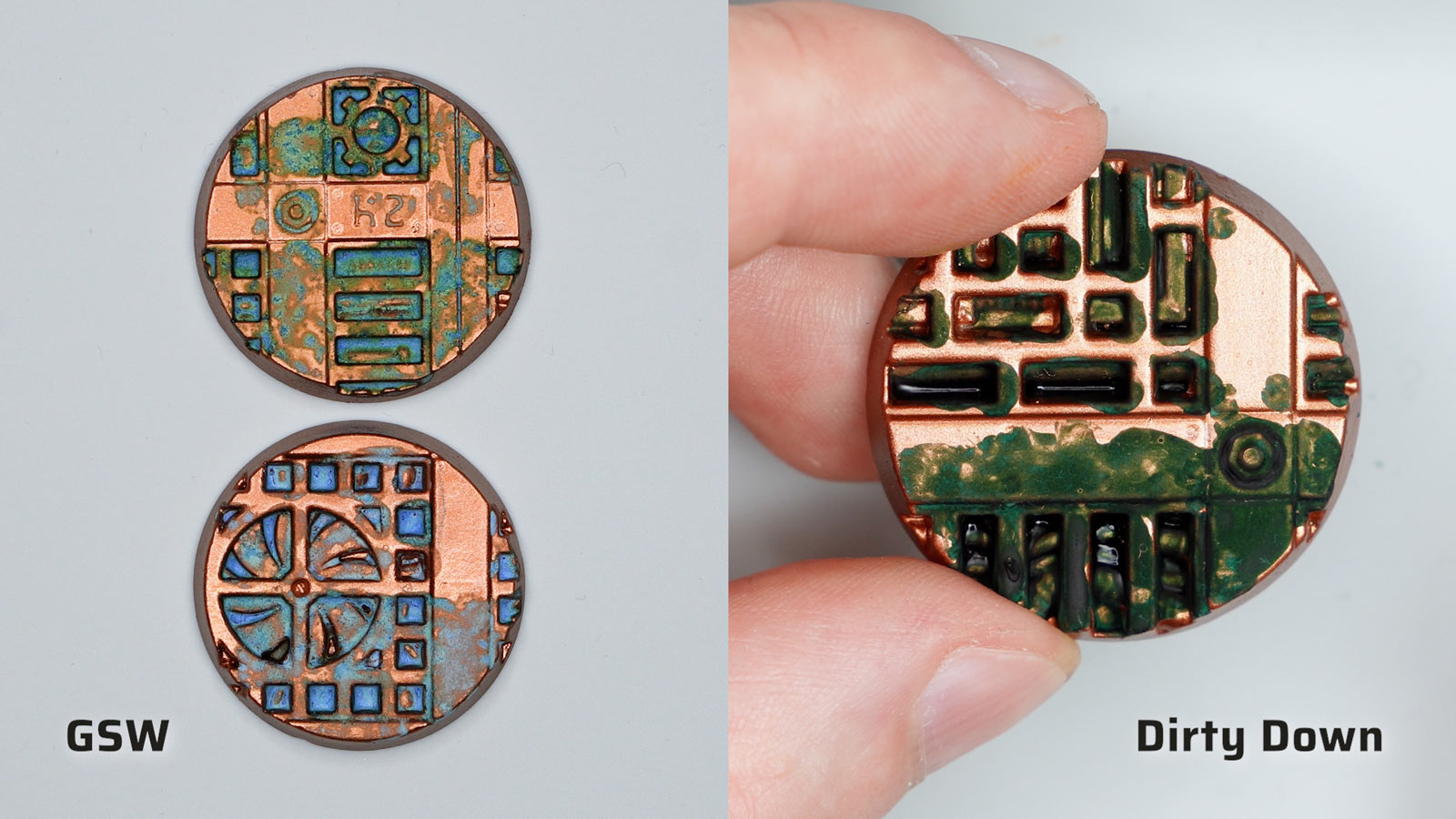
And here are the results. The Patina paints have done a really nice job. Both the greenish GSW Verdigris and the GSW Turquoise Oxide show beautiful gradients from dark to light, and the areas where the paint was a bit clumpy have actually produced a realistic grainy texture.
The Dirty Down Verdigris didn’t perform as well, despite me shaking and stirring it thoroughly beforehand. It’s very dark, and the oxidation effect is quite weak. I also ran some further tests, for example over a light beige base coat, and again it stayed quite dark. Straight over black the Dirty Down Verdigris worked a bit better, but even there the effect is weaker than with Green Stuff World, check those examples in the video. One thing is clear though: with both Green Stuff World and Dirty Down, there’s always an element of randomness in how the effect develops that you just have to embrace.
Round 2: Rust effects comparison
For the rust effect, I’ve sprayed the bases with Warpaints Air Gun Metal. I apply the GSW Yellow Oxide first, lighter at the top, a thick coat at the bottom. This one also has a bit of a texture. Then comes Dirty Down Rust. Dirty Down paints tend to gunk up at the bottom of the bottle, so you really need to shake them well and give them a proper stir before first use and after any long break. The rust paint seems particularly prone to gunking up.
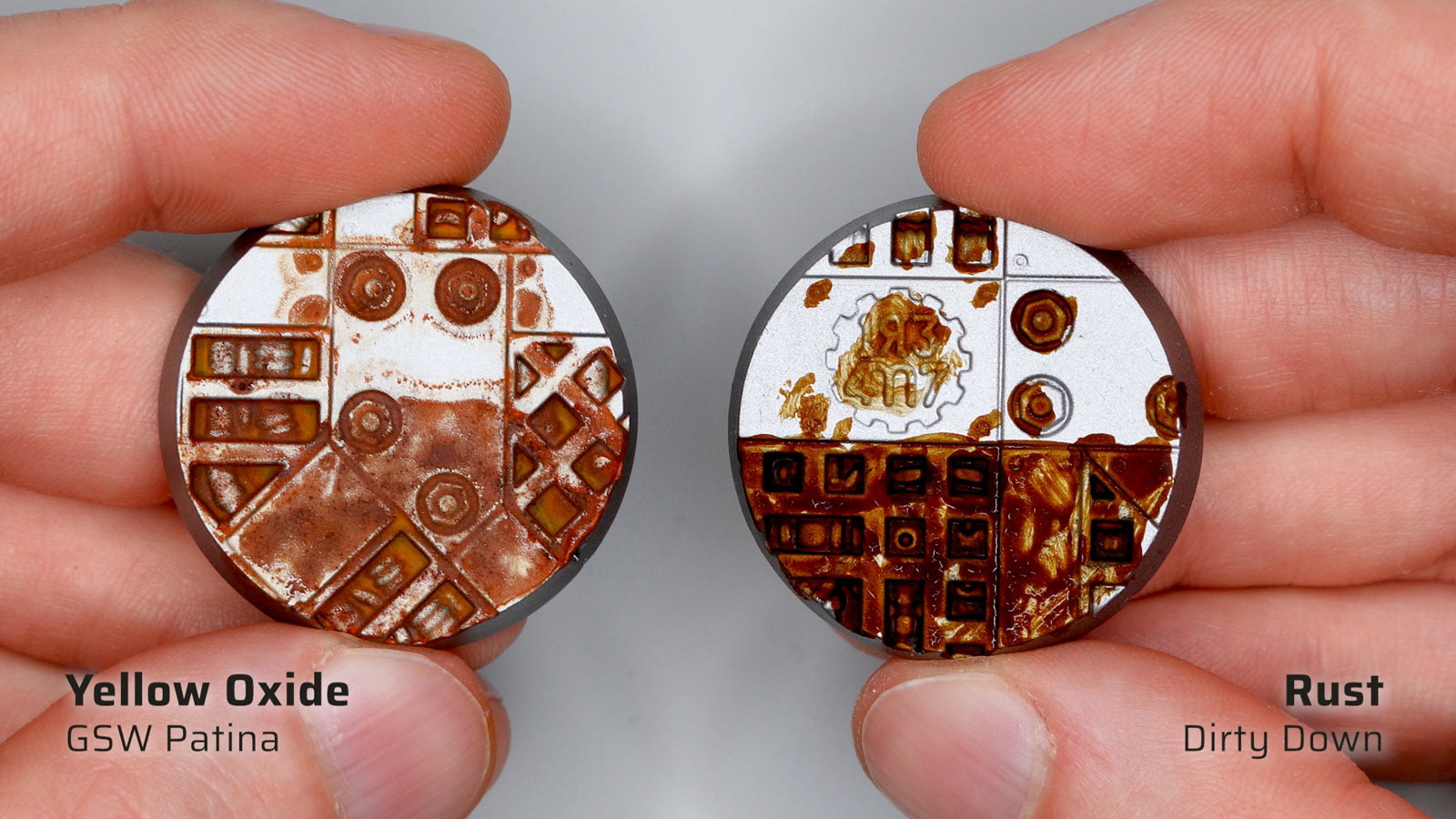
Now we wait again. Dirty Down develops within a few minutes, while Green Stuff World needed over 20 minutes. The difference here is quite noticeable. Green Stuff World Yellow Oxide has once again produced a really strong effect with plenty of texture and colour variance from yellow to orange to an orange brown. Dirty Down, on the other hand, has come out dark and more uniform. Here you can see both colours over black primer, with GSW Yellow Oxide on the left, which looks a touch more yellow compared to Dirty Down Rust on the right. So, straight out of the bottle, I’d say Green Stuff World surprisingly comes out on top again here too.
Going the extra mile with Dirty Down
But there’s a trick to getting the best out of Dirty Down paints. As the label says, they’re water-soluble, which means you can reactivate them with a damp brush, cotton swab or sponge. Let me show you on this test base, it really does work well. You can feather the Dirty Down Rust out and blend it into the silver, or lift it off to create a streaky effect. So I think with Dirty Down, you really need this extra step. The Green Stuff World patina paints are also water-soluble, but they don’t blend quite as nicely, probably because they don’t contain any solvents.
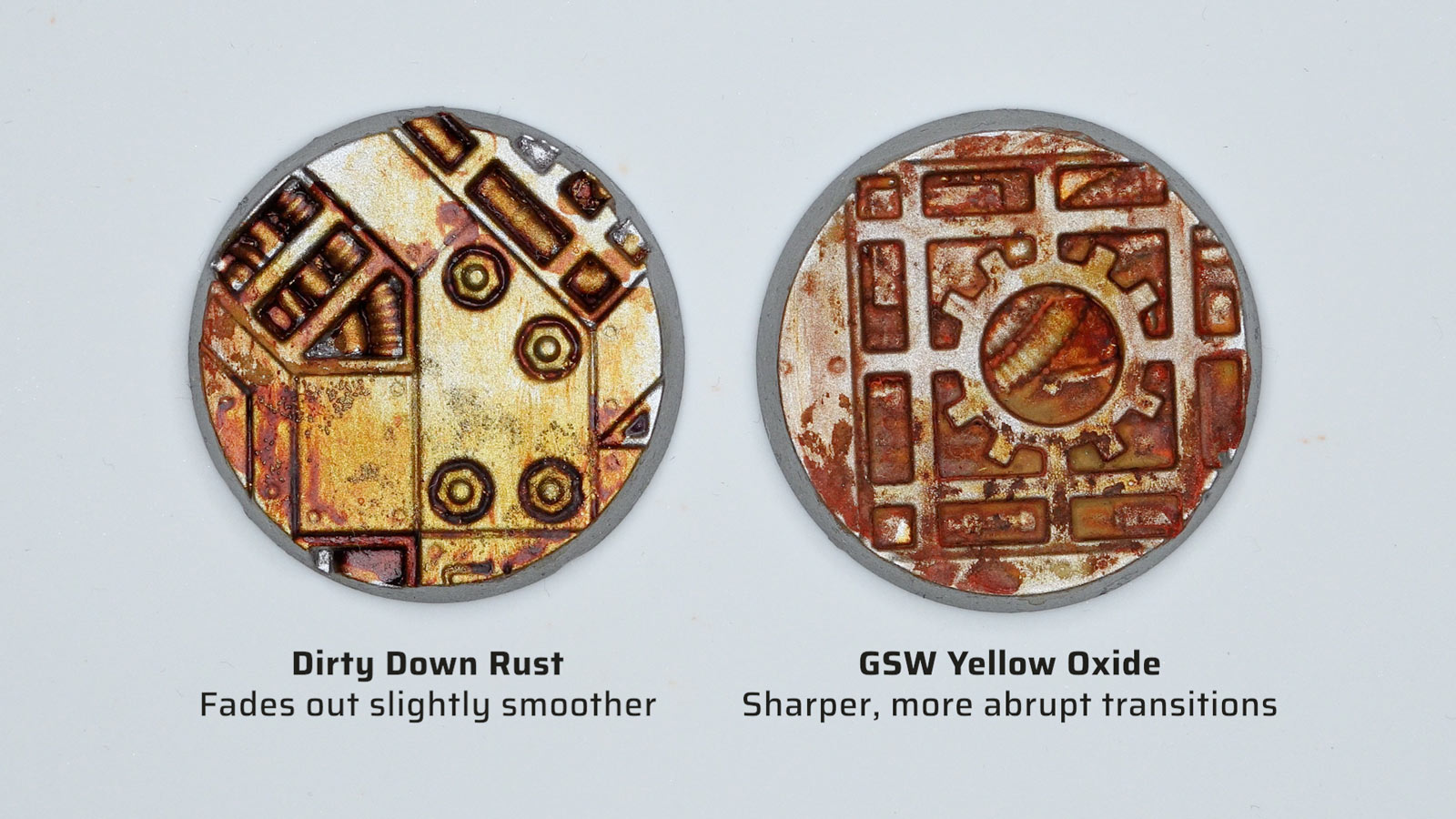
Update: Many Dirty Down Pro users have commented on YouTube that you can achieve stronger results using heat and by diluting the paints with water. Although the label says to use Dirty Down products at room temperature, I warmed up the paints with a hairdryer and gave them an extra thorough mix with a vortex mixer and a stirring rod. When applying them, I used a thinner coat by mixing in a bit of water and then used a hairdryer to make the paints dry faster. After drying, I reactivated them once more with a damp brush. You can see the results here:
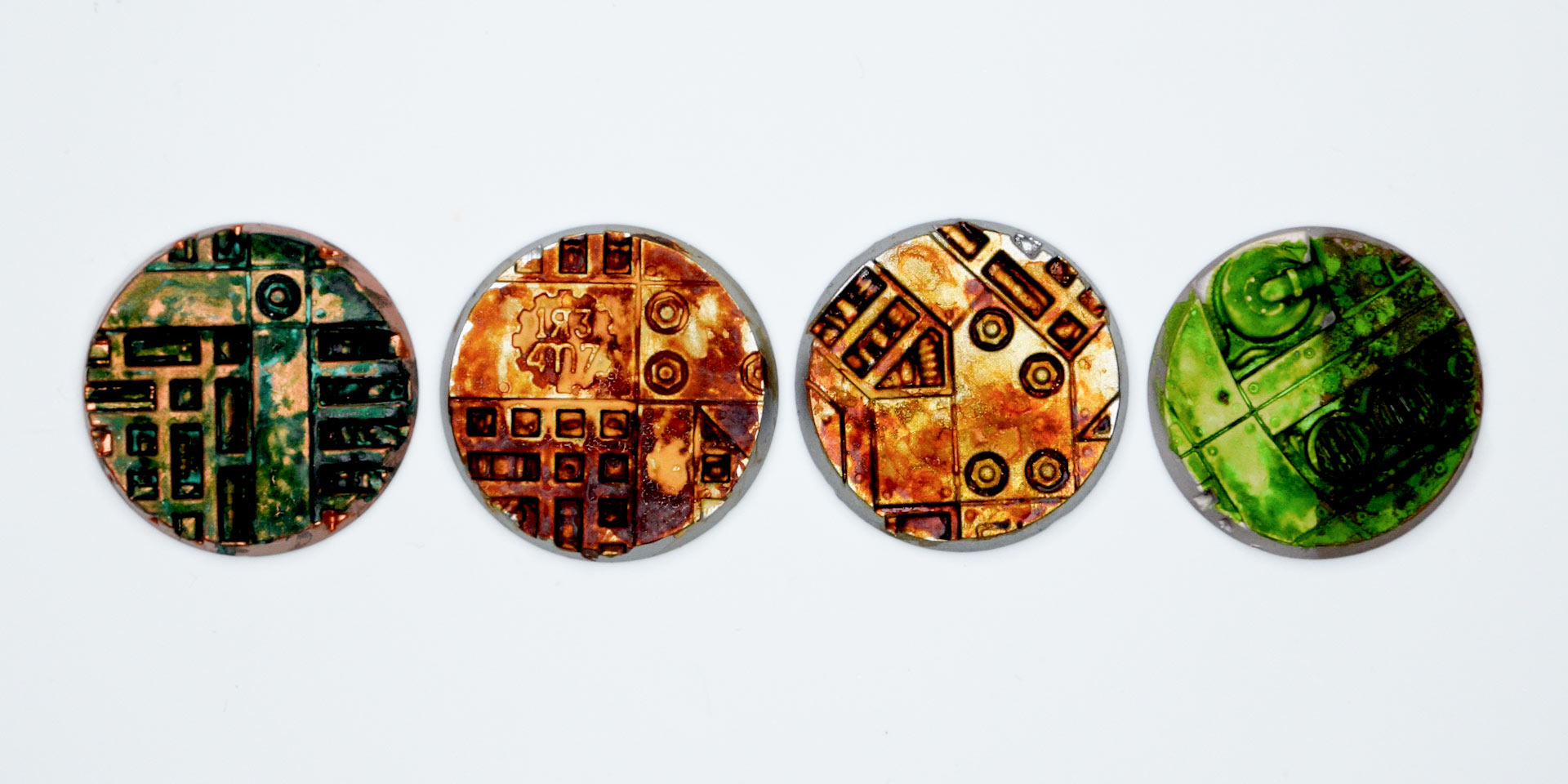
The extra tips definitely helped to achieve a stronger effect. Thanks for your advice! With the Rust, I managed to get more colour variation, and with the Verdigris, more light turquoise patches formed in the recesses. Even so, I stick to my assessment: achieving a strong result with Dirty Down really is quite a hassle (and a science in itself), whereas Green Stuff World Patina paints just work straight out of the bottle.
Whether Dirty Down or Green Stuff World, this means you absolutely need to seal these paints with a coat of varnish, because even slightly sweaty hands can make them reactivate. Also, if you paint over these paints, they’ll bleed through subsequent layers of paint.
Round 3: moss, and where Dirty Down finally pulls ahead
Round 3 is the moss. I apply the Green Stuff World version on the left base and Dirty Down on the right one. I’ve sprayed one half of the bases brown and the other beige, so we can see how each paint behaves over light and dark surfaces.
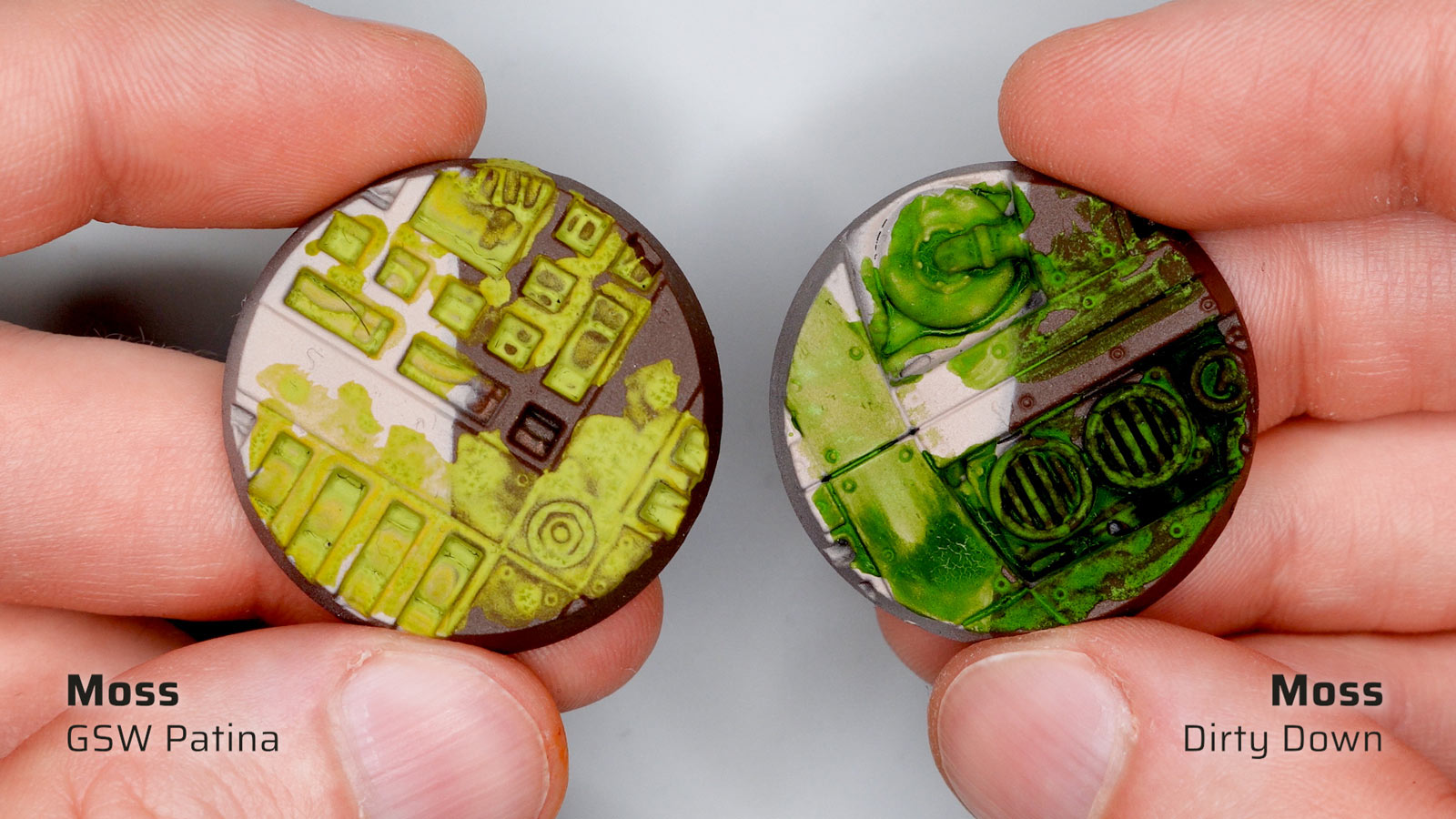
On the left is the Green Stuff World result: a very light, slightly yellowish green with relatively little texture and colour variance. The Dirty Down Moss is noticeably greener and more intense with slightly more texture. Speaking of texture, here are both moss paints over my black-primed texture palette. Both the Patina and Dirty Down paints seem to produce more colour variance when applied over a textured surface. Probably because the paint can flow into the recesses, creating areas where more and less paint collects.
Black Soot and Filthy Dirt: the two Green Stuff World exclusive colours
Now, that covers the comparison part. I’ll choose the winner at the end, but first, let’s take a look at the two Green Stuff World colours that have no Dirty Down equivalent: GSW Black Soot and GSW Filthy Dirt. Could GSW Filthy Dirt be a non-smelly alternative to Streaking Grime for weathering? Let’s find out.
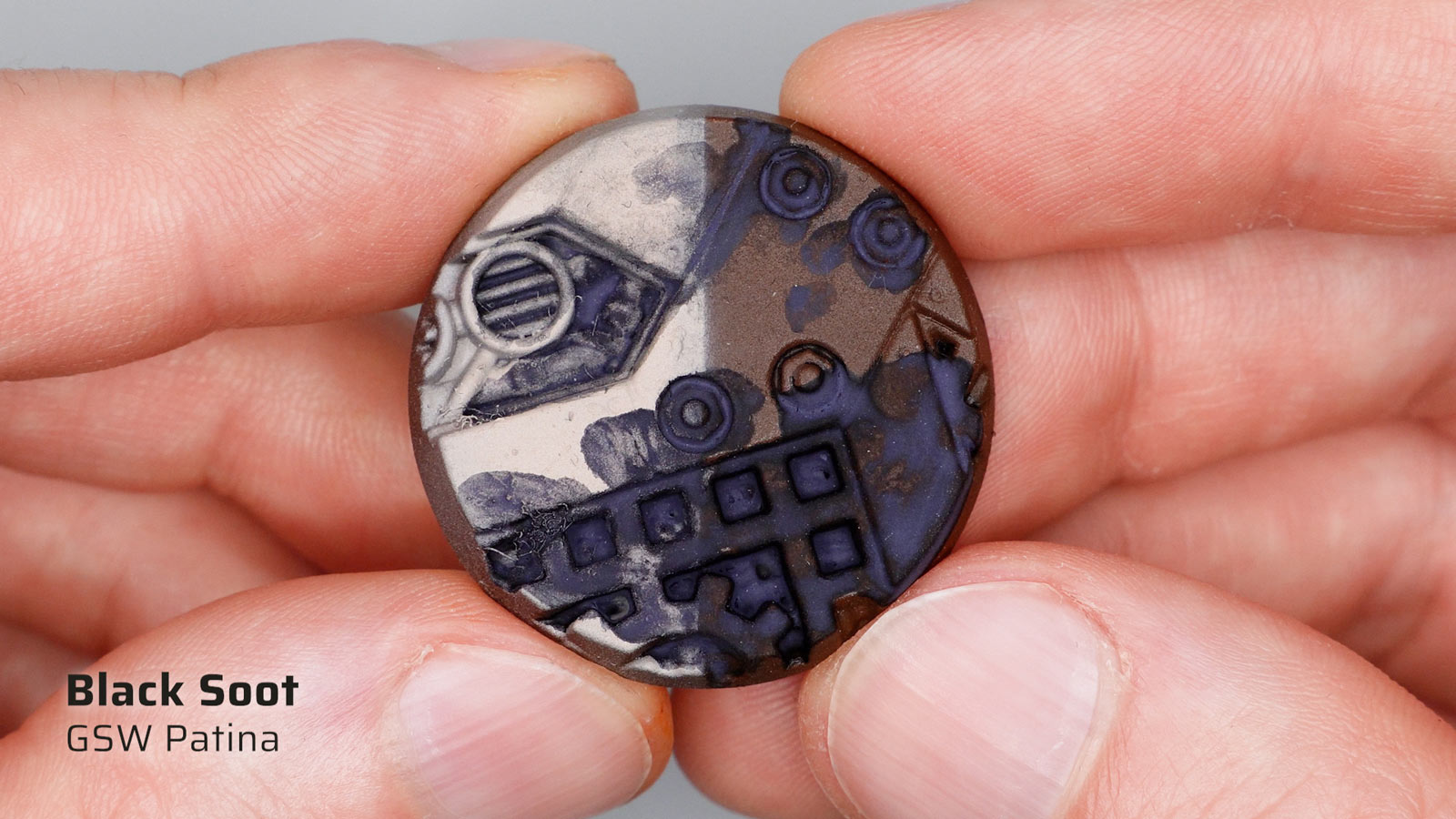
I apply the GSW Black Soot first, lighter and slightly thinned at the top, a thick undiluted coat at the bottom. After about 20 minutes, this is the result. A dark black that oxidises to a dark grey. It looks really intriguing. As the name suggests, GSW Black Soot is ideal for exhaust pipes and vents, but I can also see it working really well for grime on urban bases.
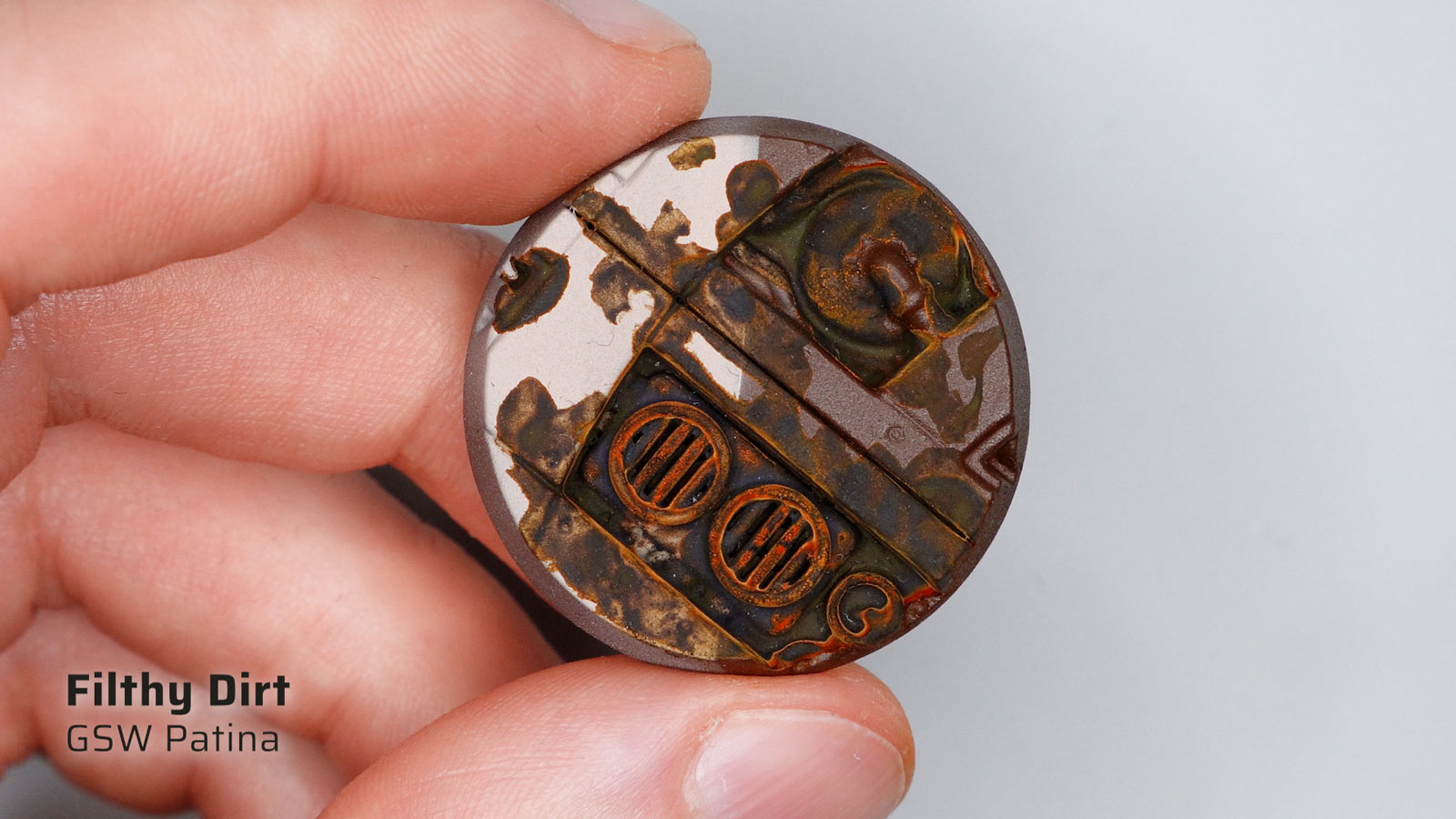
Last but not least we have GSW Filthy Dirt. I’ve prepared the same split base in beige and brown, applying less at the top and a thicker coat at the bottom. The colour that develops during oxidation is quite strong and has a lot of colour variation. Around the edges you can see some yellow-brown that transitions into a dark brown, and in some spots there’s even a hint of orange-brown coming through. Here you can see the Filthy Dirt over pure black primer on my Green Stuff World texture palette, which created a really cool effect too.
Can Filthy Dirt replace Streaking Grime for weathering?
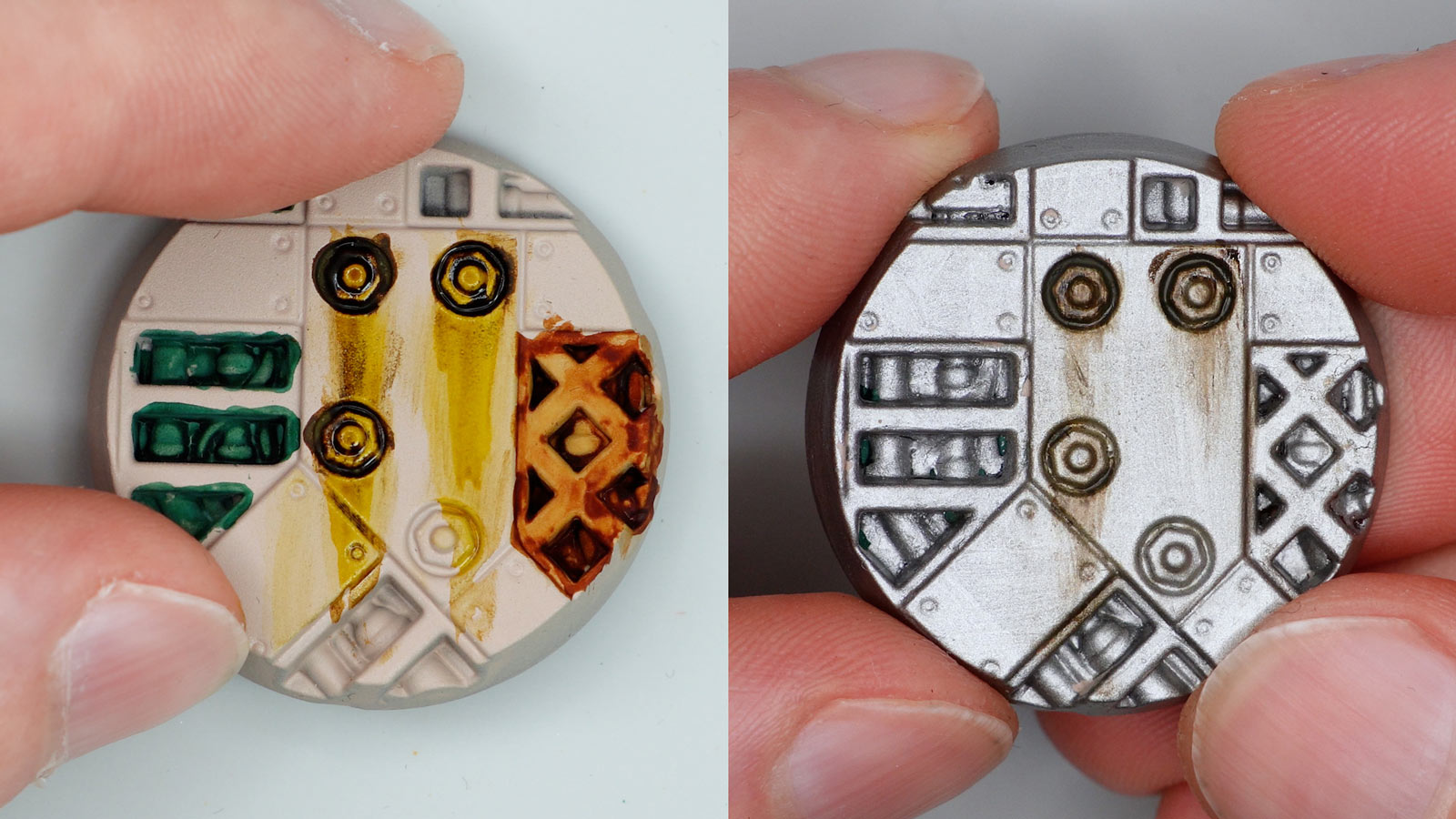
Let’s see if we can get some good streaking effects with Filthy Dirt as well. Here on a second base sprayed beige I’ve applied some streaks with Filthy Dirt. After drying, I reactivated and blended the paint with water. That kinda works, but I can’t get a perfect transition, so there is a bit of this coffee-staining effect around the streaks. Dirty Down paints, oil paints, and enamel washes like Streaking Grime do blend more smoothly with the help of a little thinner, but if you’d rather avoid solvent fumes, Filthy Dirt can be a decent weathering alternative.
A quick word on Green Stuff World’s Liquid Pigments
Talking of weathering, Green Stuff World also has a range of liquid pigments (see my review here). These are earthy-coloured washes, including rust and verdigris. But unlike regular washes, they aren’t transparent but opaque, a bit like dry pigments dissolved in medium. I’ve included them with the six Patina paints in the latest update for my Green Stuff World colour swatch, which you get for free if you’ve already have an older version. These Liquid Pigments don’t oxidise and they don’t reactivate like the Patina paints, you can see the difference for yourself in my colour swatch. My Stahly swatch system uses actual hand-painted samples that I’ve professionally digitised, and I have plenty of other cross-comparable swatches besides Green Stuff World on my Patreon.

This hand-painted swatch is available in my Patreon shop for a small donation (or by becoming an Autarch tier member). I also have swatches for Pro Acryl, AK 3rd Gen, Vallejo Game & Model Color, Citadel Colour, and more – all cross-compatible with each other so you can compare colours across different brands. Check out my shop for details.
Patina paints vs. Dirty Down: pros, cons, and the winner
Right, all paints tested, it’s time for my verdict. Which product will be my winner, and might there perhaps be an even better option out there? Let’s sum up the pros and cons before I crown the winner:
- The Green Stuff World water soluble Patina paints give you more than double the volume for the same price, contain no solvents, have a stronger effect, and more colours to choose from. On the downside, they take a long time to oxidise, they tend to gunk up the nozzles, and they don’t blend as nicely as Dirty Down when you reactivate them with water. Also, they reactivate strongly in the presence of moisture, even when varnished.
- Speaking of Dirty Down, they’re noticeably more expensive per ml, contain solvents, give off fumes, and need a good stir every single time. Straight out of the bottle the effect is often a bit underwhelming, and it’s only once you reactivate them with water that they really show their strengths.
So, on to the winner. For verdigris and rust I’d go with Green Stuff World, and soot and dirt don’t really have an alternative anyway. The only place I’d give Dirty Down the edge is Moss, where I prefer that slightly darker, more intense green, plus the fact that it’s easier to reactivate and feather out for some nice mossy transitions. Please decide for yourself, but overall, I got stronger and more consistent effects with the Green Stuff World Patina paints, and they’re more affordable and non-toxic.
Looking for more control? Here are some alternatives
But as impressive as these effect paints are, there’s one big drawback that comes with this whole category of oxidation paint: the result is always a bit random and hard to control. It works brilliantly on some colours and surfaces, and not so well on others.
If you want something more controllable, I’d point you towards the Two Thin Coats effect paints. These also have a subtle oxidation, though they tend towards more vivid colours and are better suited to high-saturation paint jobs. Another great option is the WPF Rust Effect paint from the Warpaints Fanatic range (my review here). Thinned with water or medium, you can build up the oxidation effect in controlled, thin layers.
Where to get
You can find the latest hobby products at our 🇬🇧/🇪🇺 partner stores Wayland Games, Element Games, and Firestorm Games, at 🇩🇪 Taschengelddieb and PK-Pro, and at 🇺🇸 Noble Knight Games with a welcome discount of up to 10 – 15% over RRP. If you found this review helpful, we would love it if you supported us by using our affiliate links to make a purchase (at no additional cost to you, of course). Thanks a lot, and happy hobbying!

Tale of Painters is the unofficial Warhammer hobby magazine run by hobbyists like you. Support our work by using the affiliate links from our partner stores for your next orders so we can continue to bring you fantastic FREE content every day:




Or support us directly:
