


I’ve been using the updated Vallejo Game Air range for over two years now, and here’s what I’ve learned. How do they perform for zenithal base coats and detail work? Are they really as clog-free as promised, and how do they compare to other airbrush paints? I’ll answer all of that in this long-term review.
Vallejo’s updated Game Air paints arrived in autumn 2023, and I picked up the complete range straight away. I’ve been using them ever since, and in this video I’ll give you the key facts you need to know:
I’ve also prepared plenty of demos: I’ll show you how Vallejo Gam Air handles gradients and zenithal base coats, some of my projects I’ve used them for, and how they stack up against Warpaints Air and the Warhammer Colour Air range. And at the end you’ll get my honest verdict after over two years of use. Would I recommend them, or are there better alternatives?
What’s in the Game Air range and what makes it different?
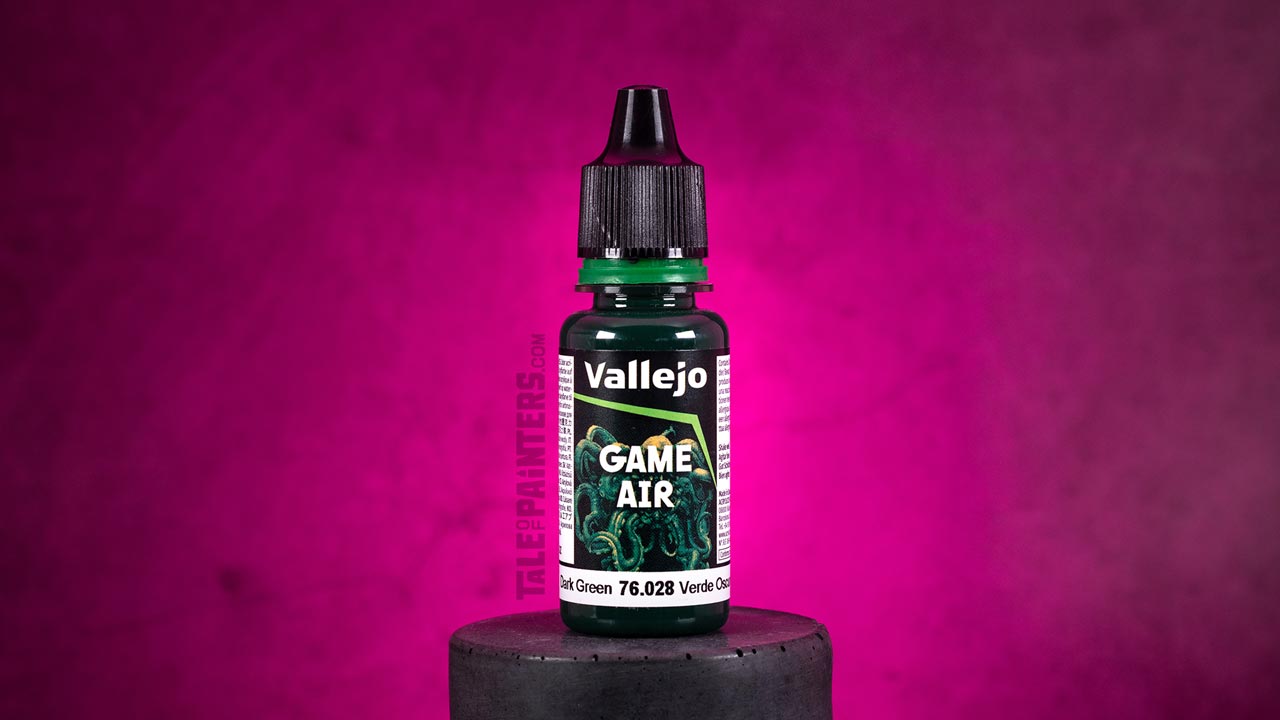
Vallejo have been super prolific lately and completely overhauled their hobby paint lineup over the past few years. In collaboration with Angel Giraldez, the Game Color range was reworked from the ground up with a brand-new formula in 2022, I did an in-depth video review on that at the time. Then about a year later, Game Air got the same treatment. The new Vallejo Game Air range comprises 51 colours, a thinner, a flow improver, and 7 primers, so 60 paints in total. There are no metallics or fluo paints in the range, well… technically there are, but more on that later. Each bottle contains 18ml of paint, and I really like Vallejo’s dropper bottles with their reinforced nozzles.
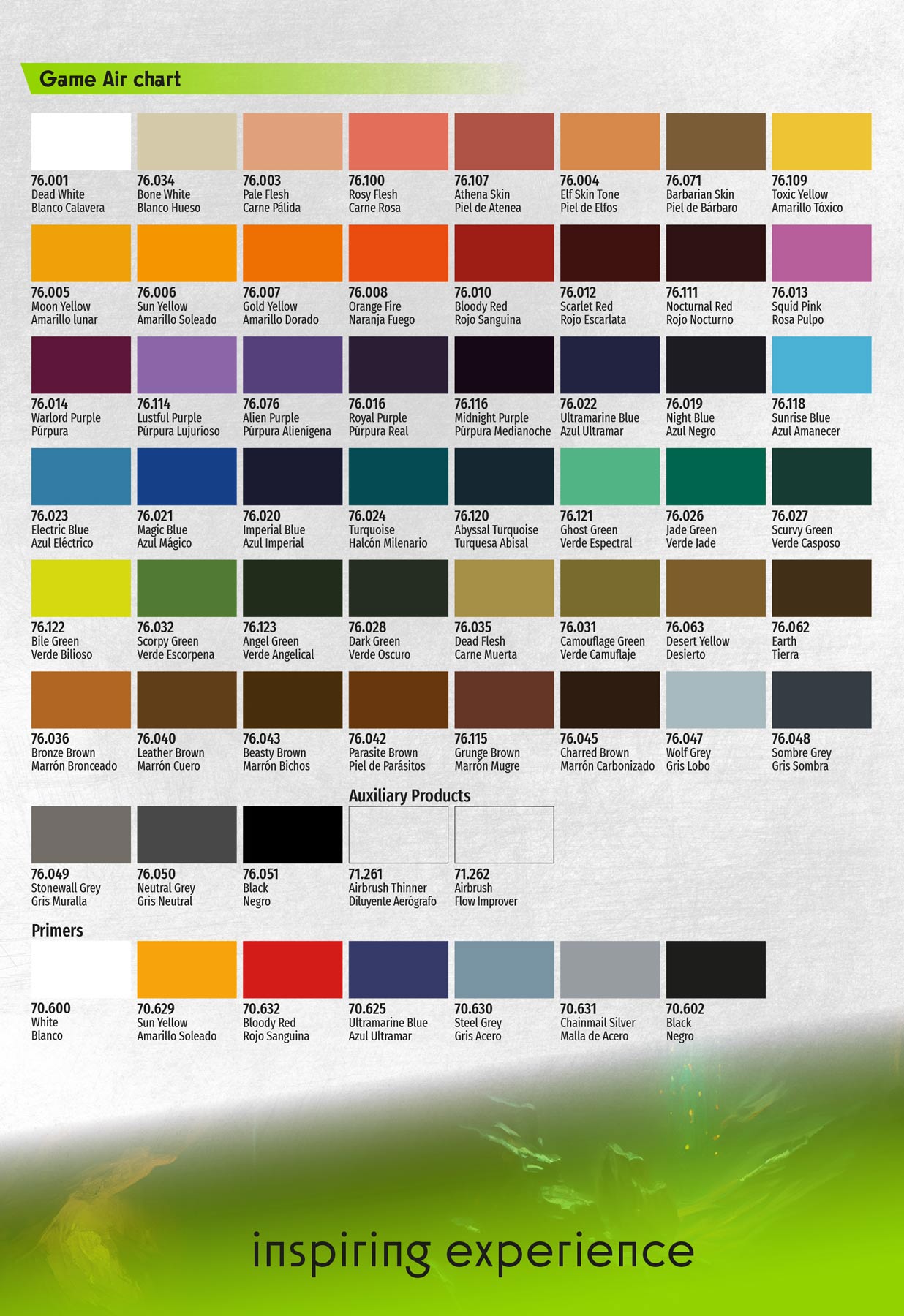
The paints come pre-thinned, so in theory you can pour them straight into the airbrush without clogging or any other issues. Whether that actually holds up in practice, I’ll explore in this review. But there’s another big selling point: the paints are supposed to perfectly match their counterparts from the Game Color range. I’ll be putting that to the test as well, so stay tuned.
First test: base coating and clog resistance in practice
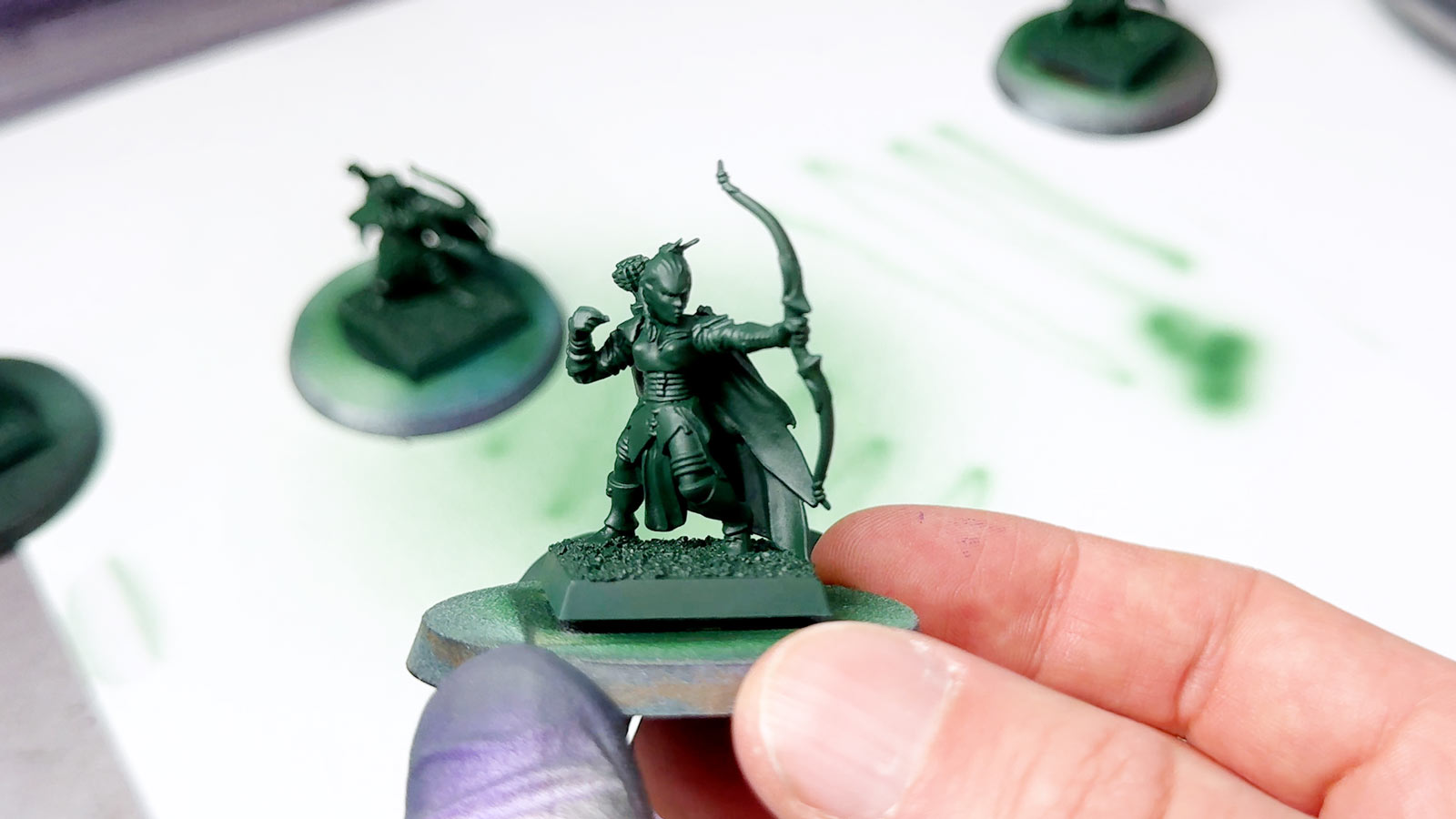
Let’s start simple. I have a few Glade Guard models for Warhammer: The Old World. I sprayed them with Renegade Green primer from The Colour Forge, but the primer didn’t reach every spot. So I’m giving them an even base coat through the airbrush using Game Air Dark Green. My weapon of choice here is the Mr. Hobby PS-289, a solid upper-mid-range airbrush with a 0.3mm nozzle. I pour the VGA Dark Green straight into the cup without thinning and set the pressure to around 20 to 22 PSI. The paint atomises beautifully and coverage is excellent. What I notice straight away is that Vallejo has clearly added a generous amount of flow improver and retarder to the formula. The paint stays wet on the model for quite a long time. I occasionally had to speed things up with a hairdryer before applying a second or third thin coat. On the flip side, there’s no tip dry or clogging even after extended spraying, and I really could pour the paint straight from the bottle into the airbrush.
Does Game Air really match Game Color? A direct comparison
Here I have Infinity’s Lament, the Aeldari Warhammer+ miniature I recently painted for my Craftworld Iybraesil collection:

I base coated the Wraithlord’s remains with Game Air Turquoise, then applied shading with the darker VGA Abyssal Turquoise, switching to a 0.2mm nozzle airbrush for that. Most colours in the Game Air range are grouped into triads, though unfortunately there’s no lighter turquoise for highlighting. So I mixed a little VGA Dead White into the VGA Turquoise, which worked perfectly well, and applied controlled highlights. Since I continued working on the model with the corresponding Game Color paints after airbrushing, it’s incredibly handy that the Game Air range matches its Game Color counterparts. But does that really hold up even though the paints sometimes look slightly different in the bottle?

I’ve put together a quick test, picking out a few colour pairs at random. On the left you’ll always see the Game Air version, with the corresponding Game Color painted over it on the right side of the model. The match is genuinely spot on. It looks like the exact same pigment mixes are used throughout. The only difference is a slight variation in finish: Game Colors are very matte, while Game Air has a softer matte with just a touch more sheen. That’s probably down to the additional additives needed to make the paints airbrush-ready. The colour match to the Game Color range is a real selling point, and in my hand-painted Vallejo Game Color swatch I’ve marked all the colours that are also available in a Game Air version. Never buy the wrong colours again with my Stahly Swatch System, you can find cross-comparable swatches for all the major hobby paint brands on my Patreon.
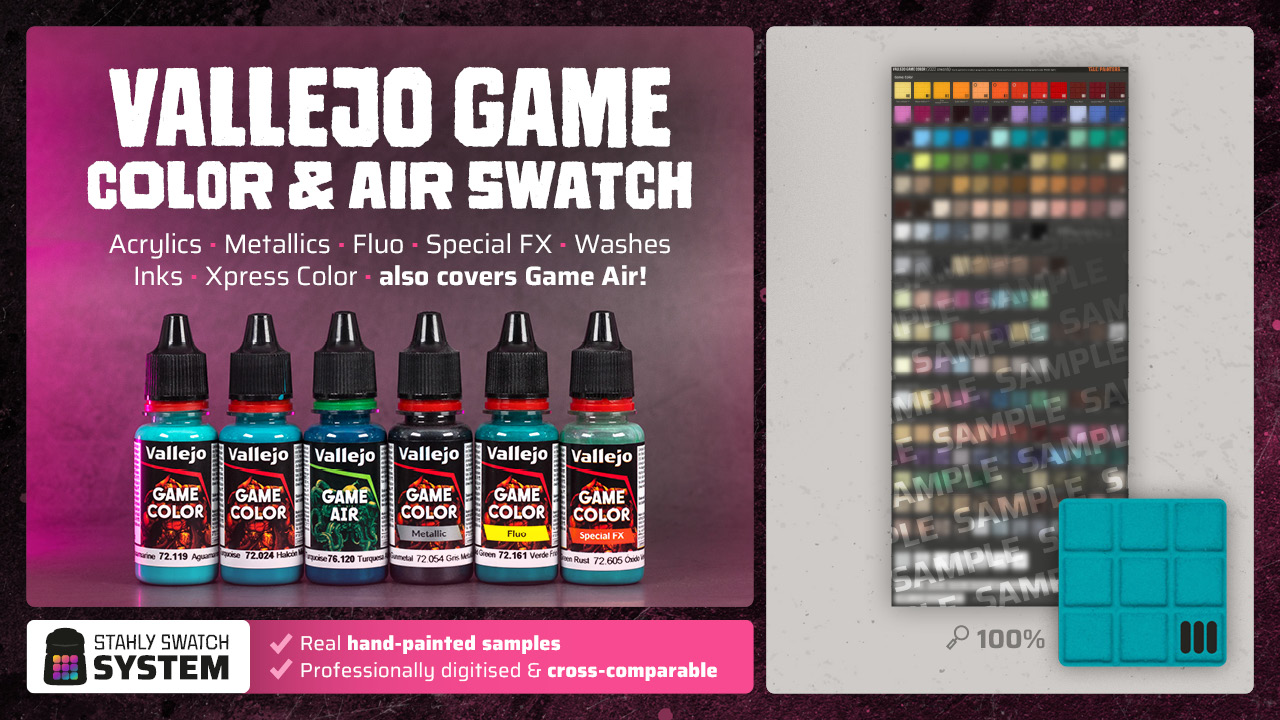
This hand-painted swatch is available in my Patreon shop for a small donation (or by becoming an Autarch tier member). I also have swatches for Warhammer Colour, AK 3rd Gen, Warpaints Fanatic, and Two Thin Coats – all cross-compatible with each other so you can compare colours across different brands. Check out my shop for details.
Zenithal base coating: how smooth are the transitions?
But how do these paints handle zenithal base coating when you want those ultra smooth transitions from dark to light? Here I’ve sprayed a model with the black primer from the Game Air range, straight over bare plastic. There are 7 primers in total, and some colours like VGA Sun Yellow and VGA Bloody Red are available both as a standard Game Air version and as a dedicated primer. The difference is twofold: finish and adhesion. The primers dry a bit more satin, and I guess they use polyurethane as binder, which is more durable than standard acrylic resins. The self-levelling properties are also pretty good. The only thing I don’t really like is that the primer sometimes becomes flaky in the cup, especially if you add a bit of thinner to it. I didn’t have any problems when spraying it, though. Adhesion and durability naturally can’t compete with solvent-based primers like Mr. Surfacer from Mr. Hobby, but for a non-toxic acrylic primer, the Vallejo primers are allright.

For the zenithal gradient I spray Game Air Dead White straight from the bottle onto the black model from above, simulating natural light direction. To achieve a finer spray pattern, I recommend adding a little Vallejo Airbrush Thinner and increasing the pressure to around 40 to 45 PSI. Atomisation is decent – you can see just a subtle texture in the transitions. One thing always worth keeping in mind: when it comes to smoothness of spray pattern, water-based acrylics can’t compete with alcohol-based acrylics or lacquer paints like those from Tamiya or Mr. Hobby. Those paints do require a solid extraction setup and proper filters in your respirator though, because the fumes are no joke. Even for regular airbrush paints I’d recommend at minimum a respirator with a fine particle filter (my recommendation for an affordable respirator mask here).
Coloured zenithal pre-shading: Game Air for Slapchop and Contrast-style painting
One of my favourite techniques is spraying a coloured zenithal base coat, like on these Tyranid Warriors.

Combined with Contrast-style paints aka Slapchop, this style of pre-shading adds more depth and life to your miniatures. For my version of the Hive Fleet Kraken scheme, I first sprayed a base coat of Game Air Scarlet Red over a dark burgundy primer from Colour Forge. Next is VGA Athena Skin at an angle. Again with a bit of thinner and increased pressure to over 40 PSI. For the final layer, I’ve switched to pure VGA Dead White, which I spray only straight from above as a final highlight. The dark red sitting in the recesses is far less harsh than pure black, and it harmonises much better with the red carapace.
Game Air vs. Warpaints Air vs. Warhammer Colour Air
Before we get to the metallics question, here’s a quick comparison with Warpaints Air and Citadel Colour aka Warhammer Colour Air. I’ve brought along this chibi EVA-01 mech kit from Tokyo and primed it black.
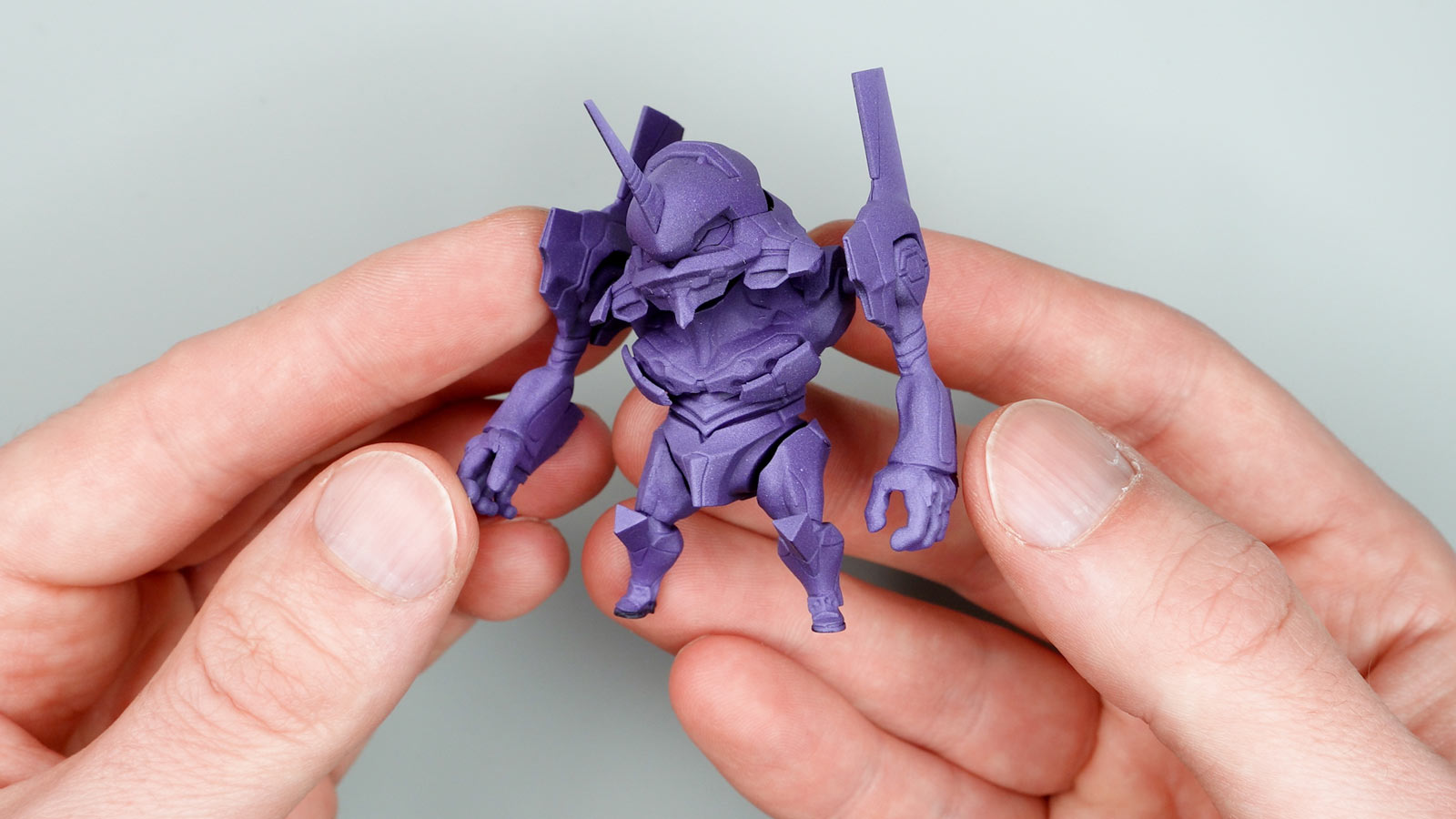
For the basecoat of the purple armour I started with Warpaints Air Broodmother Purple. Straight from the bottle it quickly caused clogging, even after pushing the pressure above 22 PSI. With Warpaints Air you should always add a few drops of thinner to be safe. For the midtone I switched over to Warhammer Air, Chemos Air, specifically. I added a small drop of thinner as a precaution, but was pleasantly surprised by how well it sprayed and atomised. The only pain was getting the paint out of the pot and into the cup. Airbrush paints that don’t come in dropper bottles really should be banned. For the highlights I moved to Game Air Lustful Purple, switching back to the Mr. Hobby PS-270 with the finer 0.2mm nozzle. Atomisation and transition smoothness were both very good. There were just one or two tiny specks here and there, but that was down to me rather than the paint.
By the way, should I make more reviews about airbrush paints, and if so, which ones? Let me know in the comments.
What about metallics and fluorescent colours?
As I mentioned earlier, what you won’t find in the Game Air range are metallics or fluorescent colours. According to the Game Air leaflet, you’ll need to turn to the Vallejo Game Color range for those. The fluo paints have a consistency that works perfectly in the airbrush, and the metallics are also thinner compared to, for example, the Model Color metallics. I did flag that in my Game Color review, finding them a touch thin for brush painting. That said, for the airbrush they’re pretty much perfect. With my 0.2mm nozzle I just added a drop of thinner and a little flow improver in an 80/20 ratio, a recipe I borrowed from Vince Venturella that’s served me very well.
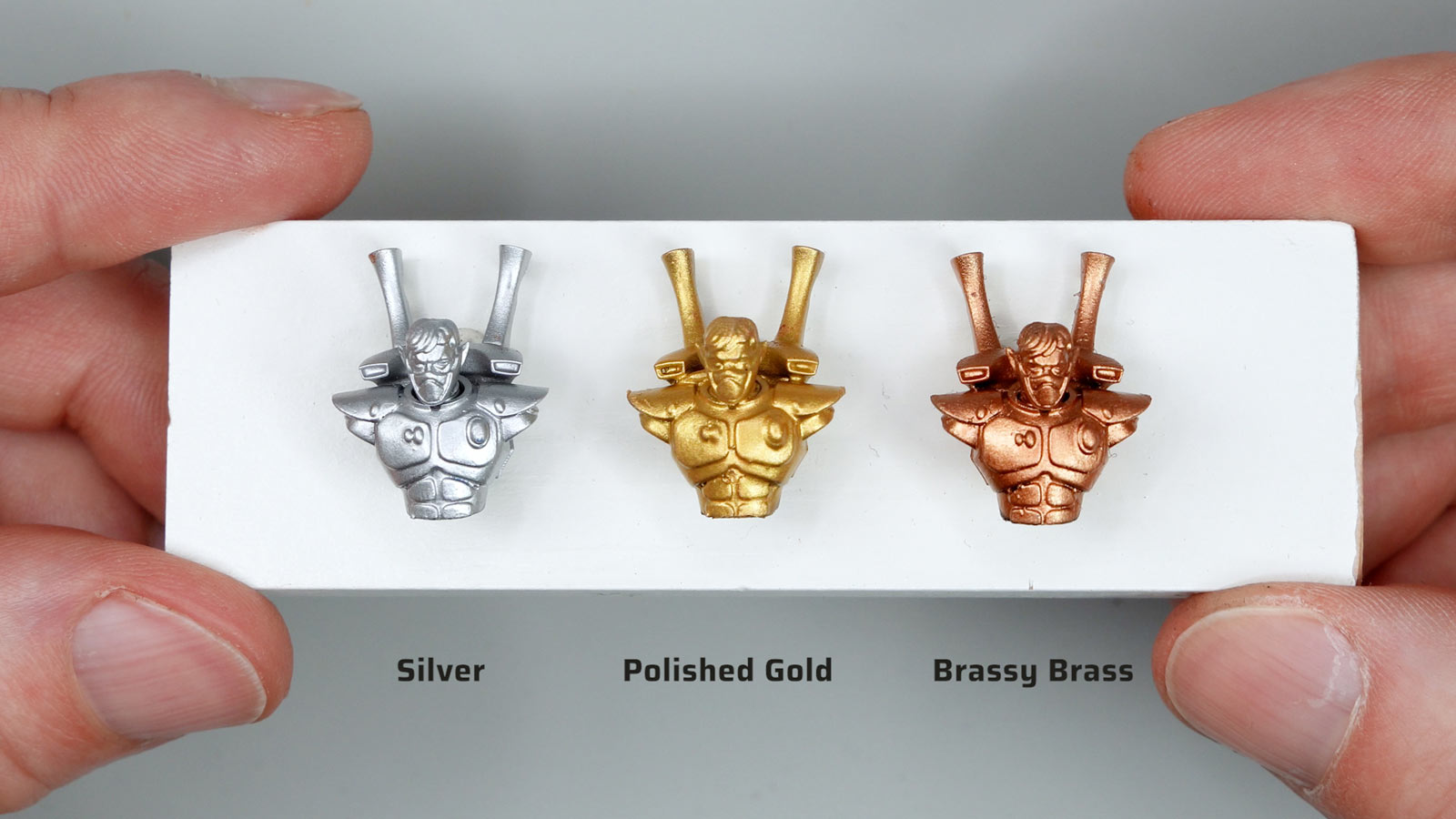
The result is fantastic, a beautiful finish with a high level of reflectivity and very fine metallic flakes. Vallejo really know how to make good metallic paints. The only weak spot is the covering power of the golds, which isn’t quite as good as the silvers and coppers. Vallejo have since released the True Metallic Metal series, which also includes pre-thinned airbrush versions. The golds there cover much better and are a solid replacement for the Game Color ones, have a look at my True Metallic Metal swatch for a direct comparison.

This hand-painted swatch is available in my Patreon shop for a small donation (or by becoming an Autarch tier member). I also have swatches for Vallejo Game & Model Color, Citadel Colour, AK 3rd Gen, Warpaints Fanatic, and Two Thin Coats – all cross-compatible with each other so you can compare colours across different brands. Check out my shop for details.
A word about airbrush paints
Of course, instead of buying dedicated airbrush paints you could always use your regular paints and thin them down. But that means experimenting every time to find the right ratio and figure out whether the thinner and paint play nicely together. Since switching to dedicated airbrush paints, clogs and problems have dropped off dramatically for me, and airbrushing became just a much more enjoyable experience overall. So while it’s not a must-have, it’s such a quality of life upgrade in my opinion.
Where to get
You can find the latest hobby products at our 🇬🇧/🇪🇺 partner stores Wayland Games, Element Games, and Firestorm Games, at 🇩🇪 Taschengelddieb and PK-Pro, and at 🇺🇸 Noble Knight Games with a welcome discount of up to 10 – 15% over RRP. If you found this review helpful, we would love it if you supported us by using our affiliate links to make a purchase (at no additional cost to you, of course). Thanks a lot, and happy hobbying!
I hope you found this review helpful, feel free to leave a reaction or comment below, or post your questions here or discuss on our Discord channel.
8.0 Score
Pros
- Truly ready-to-spray straight from the bottle with no thinning required
- Generous flow improver formula makes clogging practically a non-issue
- Spot-on colour match to the Game Color range
Cons
- Range limited to 60 colours (so not every Game Color is available as an Air version)
- Takes quite long to dry
- Water-based formula can't match the atomisation smoothness of alcohol or lacquer paints
Final Verdict
I've been using the Game Air paints for nearly two and a half years across all kinds of projects, and they became one of my favourite airbrush ranges. They atomise very well for a water-based acrylic paint, cover nicely, and thanks to the generous amount of flow improver, you really have to work hard to clog the airbrush. They are truly ready to use straight away and don't need extra thinning. Really my only criticism is that the range is limited to only 60 colours, and not every shade from the Game Color range is available in an airbrush version. Because the perfect colour match to Game Color is, for me, the single greatest advantage of this product.

Tale of Painters is the unofficial Warhammer hobby magazine run by hobbyists like you. Support our work by using the affiliate links from our partner stores for your next orders so we can continue to bring you fantastic FREE content every day:




Or support us directly:
