


I’ve tested the complete Kaleido Colorworks range from Gaahleri: Primary Colors, Automotive, Mecha Colors, and more. These pre-thinned acrylic paints are supposed to match the atomisation and durability of a lacquer paint, but without the solvents or the smell. A lot of YouTubers are raving about Gaahleri products, but I do wonder how much of it actually holds up, and what’s just hidden advertising. Here comes my honest and 100% spoon-free review.
Is the Gaahleri hype actually justified?
Many creators on YouTube seem to love Gaahleri airbrushes and paints. But you should know that Gaahleri runs aggressive influencer marketing and showers even smaller channels with products. A while back I tested the Mobius and GHAC airbrushes here on Tale of Painters, and frankly: in terms of build quality and atomisation, they can’t magically compete with brands in the 100 bucks, 200 bucks, and above bracket, whatever some reviews might suggest. They’re great entry-level and budget airbrushes, nothing more and nothing less. The new high-end Aventus range might be a different story, but I haven’t tested those yet.
So in this review I want to find out whether the Kaleido Colorworks paints are really as ground-breaking as claimed, or whether that’s been somewhat overexaggerated. And yes, I’m aware that I’m also a kind of influencer and receive products for testing. But I don’t make myself dependent on individual paint brands or accept sponsorships from them. If you know Tale of Painters and my YouTube channel, you know I always test the latest paint ranges honestly and without bias.
These items have kindly been provided by Gaahleri. Thoughts and opinions are our own.
Kaleido by Gaahleri: what I’m actually testing
But enough preamble, let’s get into the testing. First I’ll run some spray tests on actual models and test the atomisation for zenithal base coats and detail work. Second, I’ll compare the metallics and the pearlescent colours from the Automotive range against Vallejo Metal Color. Third, I’ll check how well the Mecha Color range matches Gundam Color and whether the durability holds up for panel lining and masking. And at the end you’ll get my honest verdict, comparisons with other airbrush ranges, and possible alternatives:
Priming an Ork Boy: first impressions
Here I have an Ork Boy from the Warhammer 40k starter set, and I’m priming him with matte grey primer, straight from the bottle at around 30 to 40 PSI through my trusty Mr. Hobby PS-289 with a 0.3mm nozzle. A solid mid-level workhorse airbrush that I use across all my reviews for consistency. The primer sprays beautifully and the self-levelling properties are fantastic, no thinning needed. A very crisp and smooth finish, but with enough grip for washes and Contrast-style paints. In the video is a Space Marine I sprayed with the matte black primer, and I think this will become my new go-to primer. Gaahleri also has a glossy primer meant for metallic and chrome paints.

Spraying the Primary Colours range
Kaleido paints come in 20ml dropper bottles. You can buy them individually on the Gaahleri website, or in various sets. The 24-colour sets each include a generous bottle of thinner and cleaner. At the time of this video there are 48 Primary Colours, plus 48 Automotive Colors, 48 Mecha Colors, and 12 metallic and 12 transparent clear paints.
The paints come pre-thinned and spray very well straight from the bottle, really no additional thinner or flow improver needed. For this Space Marine sprayed KCW Magenta, I’m still using a 0.3mm nozzle but lowered pressure to around 25 PSI.

One thing you must know: Kaleido paints have a high-gloss finish. Brands from the tabletop world like Vallejo Game Air and Warpaints Air have a more matte finish. Gaahleri have a few matte paints, too, but as of now, only 12 in the Primary Colours range.

Here you can see the blue in its regular and matte versions. More may come in the future, Gaahleri are very prolific and have just announced the Omni paint range, a hybrid paint focused on brush painting. Let me know in the comments if you’d like me to test those too.
Can the atomisation really rival lacquer paints?
Now I want to find out whether the atomisation really can compete with lacquer-based paints. I take the black-primed Space Marine and spray a zenithal highlight in KCW White. To get a super fine spray pattern I mixed in a drop of thinner and push the pressure up to just under 50 PSI.

The result is genuinely impressive. Alongside the Green Stuff World airbrush paints, this is the best I’ve seen from any water-based acrylic. Please note that my camera lens is extremely sharp, so the model looks even smoother to the naked eye.
Low pressure performance and shading
Let’s see how Kaleido performs at low pressure. For this, I have a Terran Marine from the Starcraft TMG. I’m spraying it black, not with the primer but with the regular black, because Gaahleri promise adhesion and durability comparable to a lacquer paint. And indeed, you can spray these paints directly onto bare plastic without too much issue. For the highlights I mix KCW Black with KCW Gray. Unlike tabletop paint brands, there’s no coordinated triad system for shading and highlighting. The range focuses more on basic colours, which means you’ll often need to mix your own shade and highlight colours. Historical colours are also pretty much non-existent. For the final highlights I use pure KCW Gray, switching to my Mr. Hobby PS-270 with a 0.2mm needle at around 15 to 20 PSI. With other brands I’d usually add a little thinner and flow improver at low pressure to prevent tip dry. But the Kaleido paints are already quite fluid, so that isn’t necessary.

Masking, coverage, and the Kaleido swatch
I want to paint the shoulder pads red, so I mask off the surrounding areas with airbrush putty. Kaleido paints are dry to the touch after 5 to 10 minutes or so, but they need a little curing time to reach their full durability. So I’d recommend waiting an hour or two before masking. The base colour for the shoulder pads is KCW Russet. Looking at the reds, I notice that most Primary Colours have very high saturation and purity, but more of an average covering power as a result. You can see that with the KCW Shine Red highlight. I need several coats to build up the colour. With tabletop paints it’s often the other way around, where additional pigments and extenders are mixed in to boost coverage, at the cost of a little saturation.

If you want to compare them yourself or convert your existing colours to Kaleido equivalents, check out my hand-painted Kaleido colour swatch. I sprayed every colour onto primed plasticard and professionally digitised them. Much more accurate than Gaahleri’s chart, and fully compatible with all my other swatches and my 7-in-1 colour matching document with over 1,200 hand-painted samples. The swatches are available for a small donation on my Patreon, which helps me keep them up to date and deliver free updates to existing swatches when new colours launch.
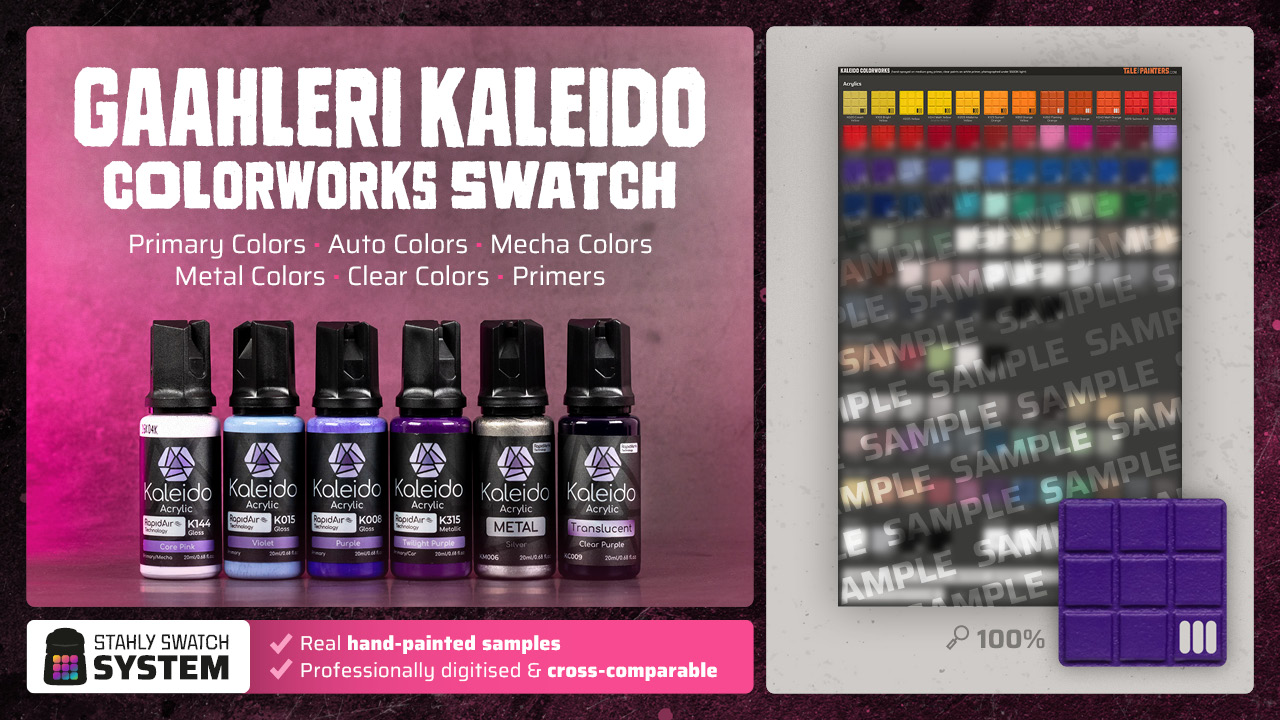
This hand-painted swatch is available in my Patreon shop for a small donation (or by becoming an Autarch tier member). I also have swatches for Vallejo Game & Model Color, Citadel Colour, AK 3rd Gen, Warpaints Fanatic, and Two Thin Coats – all cross-compatible with each other so you can compare colours across different brands. Check out my shop for details.
The Kaleido metallics vs Vallejo Metal Color
You’ve now got a solid feel for the strengths and quirks of the Kaleido paints. Let’s find out whether the metallics from the Metal and Auto Color range are up to the competition, and whether they can even rival the popular Vallejo Metal Colors.

Here I have a Stormcast Eternal, and I’m spraying her with Flashy Gold from the Metal Color range. This currently covers 12 colours: various gold, silver, and copper tones. The Automotive range also adds a few more extravagant metallic paints, which I’ll get to shortly. The result is stunning. Super fine particles and a beautiful sheen, a very intense orange gold. Truly top notch. In the video, I’ve also sprayed a Stahly test model with Silver, equally beautiful and realistic.

A few of the metallics do have a slightly grainier, sparklier finish though, like Gun Metal here, which I’m less keen on. Comparing it against Gun Metal from the Vallejo Metal Color range makes the difference clear, though fortunately it only affects a handful of colours. The gold, as I said, is excellent.
Exploring the Auto Colors and Clear range
The Automotive range contains some additional tinted and coloured metallics. The range currently covers 48 colours, a mix of regular gloss paints matched to classic automotive factory colours, metallics, and semi-metallic finishes.

Two of the semi-metallic paints plus a metallic blue gray from the Auto Color range
Here are a few examples. The KCW Lustrous Orange and the KCW Metallic Racing Red have a very subtle, pearlescent-like sheen that I haven’t seen from other manufacturers before. You can create some really interesting effects with these. Then there are more true metallics, though most of them, like this blue, are fairly subtly tinted. The coloured metallics from the Vallejo True Metallic Metal range are a bit more punchy in comparison.
There are also 12 Clear paints, essentially transparent inks. These are primarily for “candy coating”. You spray the paint, in the demo in the video, KCW Clear Red, over a light silver or gold, to create an incredibly intense tint.
Putting the Mecha Colors up against Gundam Color
But there’s more, because Gaahleri has dedicated a complete sub-range to Gunpla and Mecha builders. Can these hold up against the popular Gundam Colors and markers? Let’s find out.
Currently there are 48 Mecha Colours in two sets, designed to match the characteristic Gundam colour palette. The included leaflet has a 1:1 conversion table to Mr. Hobby’s Gundam Color, though personally I never fully trust those charts, which is exactly why I started the Stahly Swatch System.
How close is the colour match, really?
Let’s see what the colour match is really like. In the video, I spray a wing panel with KCW Cool White, straight over the bare plastic without primer. Already looks close to the white of the plastic. For the blue details I apply masking tape. As I mentioned earlier, the paint needs enough time to cure before applying tape or putty. I pick the darkest blue in the Mecha range, aiming to match the blue of the plastic as closely as possible. Then I repeat the process for this detail, going with the classic Gundam yellow. Of course, you can also paint smaller details like this using a brush; Kaleido brushes just like regular acrylic hobby paints and don’t becomes gummy or so. They are just quite thin, as they are prediluted for airbrush use.

Here’s the result. A pretty good match, though the yellow from the Primary Colour range would probably have been an even closer for the yellow plastic. To be fair, hitting an exact colour match for colour correcting parts is nearly impossible. In the video, I show another wing panel I painted with markers from DSPIAE, and those aren’t a 100% match either. So I’d say the Mecha Color palette definitely reads as Gundam, and with 48 colours there’s plenty of choice to fine-tune your paint job. But, if you want no colour differences at all, you’ll need to paint the kits completely rather than just picking out parts. The same is true for Gundam Colors though.
Panel lining and long-term durability
Gaahleri also promise that the paints are durable enough for panel lining. Let’s put that to the test using Gundam Pour markers and the fairly aggressive Tamiya Panel Liner, which is enamel-based. The high-gloss finish of the Kaleido paints definitely helps, the panel liner flows in nicely. For removing the panel liner after it has dried, both white spirit and odourless thinner work without stripping the paint. Lacquer-based paints like Gundam Color contain solvents and come off very quickly with white spirit or alcohol, so this is a real advantage for Kaleido. However, the pour marker could only be removed with the eraser marker. Unfortunately, this melts the paint, as seen in the video. So test your chosen panel liner on a spare part beforehand, and allow the paint to cure sufficiently first.
Where to get
Gaahleri Days are on right now with loads of deals on Gaahleri’s webstore, like 12 Kaleido paints for the price of nine until Sept 15, 2026. With my code Stahly you can get an extra 10% off. Gaahleri’s Amazon store also has frequent deals and discounts.
You can find the latest hobby products at our 🇬🇧/🇪🇺 partner stores Wayland Games, Element Games, and Firestorm Games, at 🇩🇪 Taschengelddieb and PK-Pro, and at 🇺🇸 Noble Knight Games with a welcome discount of up to 10 – 15% over RRP. If you found this review helpful, we would love it if you supported us by using our affiliate links to make a purchase (at no additional cost to you, of course). Thanks a lot, and happy hobbying!
I hope you found this review helpful, feel free to leave a reaction or comment below, or post your questions here or discuss on our Discord channel.
8.5 Score
Pros
- Sprays smoothly straight from the bottle, no thinning needed
- Atomisation and durability really rivals lacquer paints
- Fantastic non-smelly, non-toxic primers
Cons
- High-gloss finish limits appeal for matte-focused tabletop painters
- No triad system, so shading and highlighting need custom mixing
- Historical, tank, and aircraft colours completely absent
Final Verdict
I promised you an honest and critical review at the start, and I have to say: Gaahleri haven't overpromised here. These paints really do spray almost as smoothly as lacquer paints, don't need extra thinning, and the durability is excellent, even on bare plastic. The primers are fantastic, and the metallics (with a few exceptions) can hold their own against Metal Color. If you want to airbrush vibrant, high gloss colours, then this is your paint range. But be aware: the colour palette and the gloss finish cater primarily to car and Gundam modellers.

Tale of Painters is the unofficial Warhammer hobby magazine run by hobbyists like you. Support our work by using the affiliate links from our 🇺🇸 / 🇨🇦 partner stores for your next orders so we can continue to bring you fantastic FREE content every day:



Or support us directly:
