


A new edition of the iconic Warhammer Quest board games is always something rather special. After Blackstone Fortress and Cursed City, 2025 sees the return of the series. But Warhammer Quest: Darkwater does quite a few things differently: A flat-lay map book instead of tiles, ability cards instead of dice, and a brand-new optional skirmish mode. Whether all these changes come together, and whether they justify the eye-watering price tag, is what we’ll be exploring in this review, along with a look at the gorgeous miniatures and their sprues.

Warhammer Quest Darkwater will be available for pre-order starting Saturday, 29 November 2025. The pre-order period lasts two weeks, with the official release date set for 13 December 2025. The RRP is £160 / 206 € / $255.
According to Games Workshop, Darkwater will be a permanent addition to the range, but it might be possible that the first production run could sell out quickly, with weeks or even months for a restock to arrive. Let’s hope Games Workshop has learnt from the botched Cursed City launch.
Included in the box are:
- 49 miniatures and tokens: 7 heroes (and the spirit Wisper), plus Gelgus Pust, Belga the Cystwitch, Mulgoth the Cleaver, Shaman Foulhoof, 2 Cankerborn, 3 Blight Templars, 8 Pestigors, 14 Pox-Wretches, 6 Mire Kelpies, and 4 loot tokens
- a 36 pages rulebook plus quickstart guide
- a large lay-flat map book with 20 double-sided maps
- hero and enemy reference cards, plus ability cards
- 3 campaign act decks with encounter cards, boss encounter cards, and event cards
- 3 campaign act reward decks and a bonus card deck
- 2 token sheets and dice
- storage boxes for collecting cards and tokens for pausing campaigns between sessions

Unboxing Warhammer Quest: Darkwater
In this 4K video, I lift the lid on the (heavy!) Darkwater box and show you the sprues first, followed by the folder containing the game components and flipping through the rules and map book:
Unfortunately, Darkwater doesn’t include an insert for the miniatures, as you might know from other miniature board games or the “smaller” Games Workshop titles like Blitz Bowl.
A closer look at the Darkwater models
All 49 models and tokens come on sprues and need to be clipped out, as it’s typical for Games Workshop model kits. All figures are monopose push-fit sculpts, meaning you can assemble them without glue. For a better fit and fewer gaps, though, I recommend clipping off the pegs and using glue instead.
The Heroes of the Jade Abyss
The seven characterful heroes (plus Whisper, Jacobus Wyne’s familiar) are spread across a sprue made up of two segments, cast in an ivory-coloured plastic. Most models are assembled from four to five puzzle-like parts, with only the centaur-like Kelthannor being a little more complex. Seam lines have been hidden as much as possible, only Edmark Valoran’s doublet shows a noticeable seam where the two halves meet.

Patreon bonus content: Ultra high-res, uncompressed versions of these sprue images (and backsides of the sprues) can be downloaded here.
Base sizes are as follows: 60 mm oval for Kelthannor, 40 mm for Drasher Vorn, 32 mm for Edmark Valoran, 25 mm for Whisper, and 28 mm for the rest.

The Scions of the Plaguefather
The second medium-sized sprue contains the bosses: Gelgus Pust, the Prince of Sores, plus Belga the Cystwitch (40 mm base) and Shaman Foulhoof (32 mm base). Gelgus is perhaps not as large as one might expect, standing on “only” a 50 mm base. Even so, the sculpt, with its grotesque proportions and malicious grin, is a real highlight. There are some seam lines on the left arm, but assembly is otherwise straightforward. Belga is a touch more intricate to build, but the creative design more than makes up for it.

Patreon bonus content: Ultra high-res, uncompressed versions of these sprue images (and backsides of the sprues) can be downloaded here.
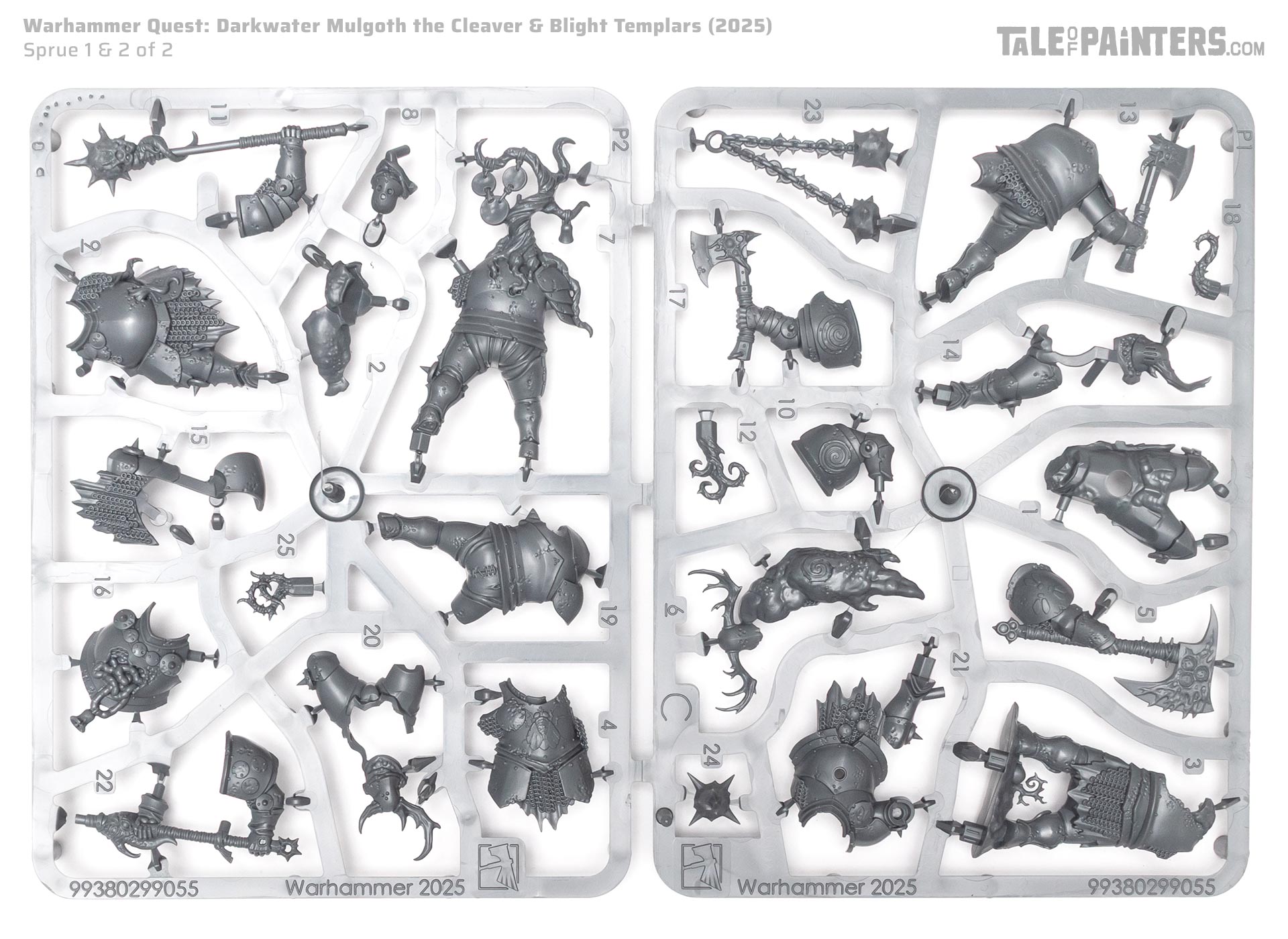
The third sprue consists of two small segments and includes Mulgoth the Cleaver and the three Blight Templars, all on 40 mm bases. While the newly revealed Putrid Blightkings sculpts seem to have grown too obese for their armour, the swollen bodies of the Blight Templars still just about fit into their blunt battle plates, giving them a heavily armoured, imposing appearance.
The fourth sprue is a single small segment and contains the two Cankerborn on 40 mm bases, plus two loot tokens on 25 mm bases. Assembly is simple with only a few parts, and seam lines are well concealed. Cankerborn are daemonkin, twice the size of Plaguebearers. They erupt wherever a site of magical power is so deeply corrupted that the spirit of the realm is driven into madness.

Finally, we have the two sprues containing the 8 Pestigors, 14 Pox-wretches, 6 Mire Kelpies, and 2 additional tokens. These sprues are identical and each consist of two medium-sized segments.

Patreon bonus content: Ultra high-res, uncompressed versions of these sprue images (and backsides of the sprues) can be downloaded here.
Because they’re identical, you’ll have every pose twice. However, each Pestigor and Pox-wretch comes with at least one alternative part, giving you some welcome visual variety:
- Pestigor sculpt 1: choice of right arm with hammer (part 7) or axe (8)
- Pestigor sculpt 2: choice of right arm with club (13) or blade (14), plus a choice of two shields (15 and 16)
- Pestigor sculpt 3: choice of head–belly plate with spear (20) or pick (21)
- Pestigor sculpt 4: choice of two-handed sickle (25) or axe (26)
- Pox-wretch sculpt 1: choice of right arm with flail (32) or axe (34), plus choice of two heads (31 and 33)
- Pox-wretch sculpt 2: choice of right arm/head section with axe (36) or sword (37)
- Pox-wretch sculpt 3: choice of right arm/head section with hammer (41) or cleaver (42)
- Pox-wretch sculpt 4: choice of right arm/head section with sickle (45) or hammer (46)
- Pox-wretch sculpt 5: choice of left arm/head section with shield (48) or axe (49)
- Pox-wretch sculpt 6: choice of right arm/head section with sword (53) or club (53)
- Pox-wretch sculpt 7: choice of left arm with shield (56) or axe (57)
A look into the game components and gameplay
The Darkwater rulebook runs to 36 pages and is printed on high-quality paper with a reinforced cover. The rules take up 16 pages: 10 pages of core rules and 6 pages covering game modes and campaign rules. The remaining pages are lore, packed with artwork and stories that gives us more insight into the Jade Abbey, and introduces the various heroes and villains. The back cover features a very handy quick-reference page. For your first game there’s also a quick-start sheet with a QR code linking to an explanatory video.

The heart of the game (aside from the miniatures) is the high-quality map book. Closed, it fills the entire box at 42,7 × 29 cm (42,7 × 57,4 when open). For a game you simply open the book and choose one of the 20 double-sided hex-map layouts according to the encounter card setup. There’s no spiral binding, yet the book still lies perfectly flat.
You also get three card packs for the three individual acts of the campaign. Each of these packs contains encounter cards with game setups, the first pack also has all the character and enemy reference cards. The three smaller card decks contains the ability and equipment cards, plus the reward cards. The final pack has the bonus cards you can acquire after each act, for example, to unlock more heroes.
Last but not least, the box includes tokens, proprietary black and red enemy action dice, and some boring white dice that simply shouldn’t have a place in a £160 / 206 € / $255 game.
Core rules and gameplay
Darkwater is a co-operative game for 1 to 4 players. You choose four heroes (at first only four are available, with three more to unlock along the campaign) and distribute them as evenly as possible among the players. This means that with three players, one player has to control two heroes, while the others can only play one. One player is designated as leader, which grants certain privileges. Enemy behaviour is driven by two colour-coded D6s. Depending on the results, enemy models follow different movement and attack patterns. There’s no need for a gamemaster or app as enemy actions are resolved collaboratively.
The core rules are presented with exemplary clarity. Lots of diagrams, subheadings, icons, bullet points, with key terms highlighted in bold text. Very clean, very intuitive. Generally, the rules are written in pretty clear English. Though the dense and semantic language that has become the standard for most Games Workshop games shines through here and there, especially on the cards.
Mechanically, Darkwater diverges a lot from previous Warhammer Quest titles. Instead of dungeon tiles, you move across rectangular open hex-maps, which makes movement and combat quite similar to Warhammer Underworlds, especially with shared mechanics like snare and lethal hexes. The book includes 20 double-sided maps. While visually diverse, they’re all the same rectangular shape. A bit more variety in shapes (as seen in Gloomhaven: Jaws of the Lion, which also uses a map book) would have been welcome.
The action dice mechanic from previous Warhammer Quest games has been replaced with a card-driven system. Each hero has three cards representing their core abilities (Move, Aid, and Attack). “Tapping” a card generates energy, which you can spend either to perform that card’s action or to activate an action on another untapped card. This allows you to trigger an ability multiple times per round at the cost of sacrificing other actions. For example, this is vital for movement: by default, heroes move 1D6 hexes, but by generating and spending an extra energy you can sprint the full 6 hexes.

The two game modes explained
There are two game modes: Campaign (around 10 to 14 hours, with built-in pause functionality) and Skirmish (around 30 minutes).
The Campaign Mode comprises three acts of increasing difficulty. Each act is generated using one of three act decks. Each deck includes loads of encounter cards (= setup cards), event cards, rest site cards, and boss cards, 96 cards in total. From this, you draw one random boss card and 14 additional cards to build an act stack for your campaign. Each game round, the players draw two cards from this stack, read out the story text on both, and decide which encounter to play. The other card is discarded. Reward cards can be picked up along the way; while completing the act might grant bonus cards and unlock more heroes. The boss card is always last in the stack, meaning that with 14 cards (of which half will be played out) the boss encounter arrives after seven rounds as the act’s finale.

Campaigns need not be played in a single sitting. The rulebook explains precisely how to pause and resume. The box also includes several storage boxes for hero, reward, and act cards, plus tokens, so you can pick up right where you left off. It’s great to see the designers thinking through such quality-of-life features.
The Skirmish Mode is simply a single encounter, chosen freely from any act deck. With a very basic quest point mechanic you can chain several skirmish games to build up towards a highscore.
What Warhammer Quest: Darkwater is (and what it’s not)
I’d describe Darkwater more as a narrative, co-operative skirmish battler rather than a traditional dungeon crawler. The rules are streamlined, the gameplay is intuitive, and thanks to the map book, the setup time is short and the tablet footprint not excessive. Individual encounters play quickly, and the campaign doesn’t drag on endlessly (plus, with the included storage boxes, it’s easy enough to pause). Because the decks are assembled at random, the campaign’s replay value is virtually limitless, and the skirmish mode is ideal for a quick game. An ideal beer-and-pretzels “ameritrash” board game. And the miniatures are, of course, gorgeous.
On the other hand, if your enjoyment of this sort of campaign game depends on following a tightly scripted story book from start to finish, Darkwater won’t scratch that itch. The gameplay and campaign system are not as deep and immersive as popular dungeon crawler games of recent times, and leans heavily on D6 randomness. The maps are all fairly similar (not visually, but in terms of shape and layout), and many of the encounters – particularly in the early acts – are a touch basic and samey. Darkwater isn’t ideal for three players, as four heroes need to be divided between three people, and because one player is designated as the leader, it can exacerbate the classic alpha-player issue that co-operative games often struggle with.
Where to get
You can find the latest GW releases at our 🇬🇧/🇪🇺 partner stores Wayland Games, Element Games, and Firestorm Games, at 🇩🇪 Taschengelddieb and PK-Pro, and at 🇺🇸 Noble Knight Games with a welcome discount of up to 20% over RRP. Using our links helps to support Tale of Painters at no additional cost to you, so thank you very much for using them!
I hope you found this review helpful, feel free to leave a reaction or comment below, or post your questions here or discuss on our Discord channel.
8.0 Score
Pros
- 49 fantastic push-fit miniatures and tokens
- High-quality large format flatlay map book
- Intuitive, accessible rules and pausable campaign system
- Quick setup, modest footprint, and fast gameplay without the need of a Gamemaster or app
- Quick-play skirmish mode
- High replayability due to randomly generated campaign acts
Cons
- Less models than in Cursed City for a heavily inflated price
- No insert for the miniatures
- For 3-player games, the four heroes need to be split unevenly
- Map layouts are very samey
- Some of the earlier encounters are a bit basic in design
Final Verdict
The value of the eye-wateringly expensive Darkwater box comes chiefly from the hallmarks of Games Workshop’s craft: the richly realised setting, the high production values, and above all the brilliant miniatures. The game itself is somewhat secondary if you're honest. Even though Darkwater is, mechanically, the most elegantly designed Warhammer Quest to date. Thanks to its intuitive, streamlined rules, it’s well suited as an entry point into the world of narrative campaign board games. Those seeking greater mechanical depth will be better served by Gloom-/Frosthaven or the Nemesis series – and at half, or even a quarter, of the price.

Tale of Painters is the unofficial Warhammer hobby magazine run by hobbyists like you. Support our work by using the affiliate links from our partner stores for your next orders so we can continue to bring you fantastic FREE content every day:




Or support us directly:


